
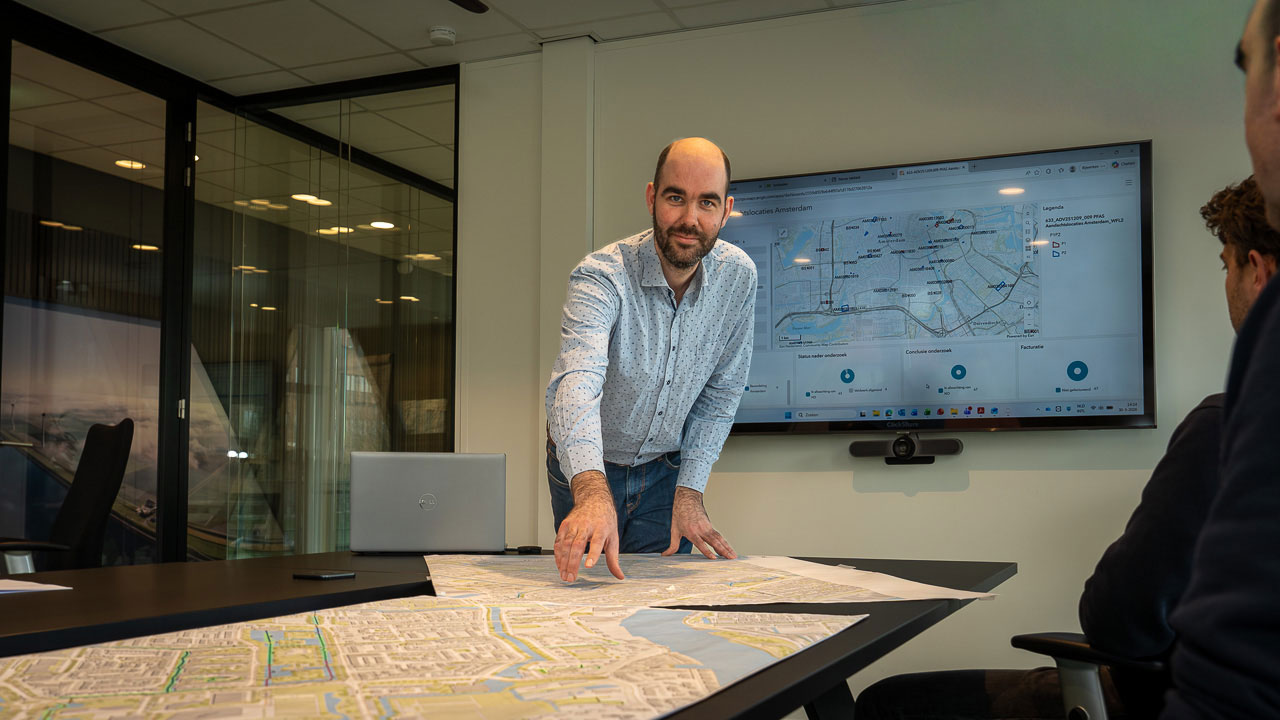
Tetra Tech’s Julian Hartman shares how we are supporting the City of Amsterdam in the Netherlands with a structured, risk-based approach to PFAS investigations that helps turn uncertainty into practical decisions for people and places.
PFAS can be difficult to see, difficult to trace, and difficult to explain. In Amsterdam, that challenge has become a practical working method: investigate intelligently, focus on exposure risk, and make decisions based on evidence. Together, the municipality and Tetra Tech are building a clearer picture of where PFAS may be present, how it may have spread, and what action is truly needed.
A structured response to an invisible problem
PFAS has become one of the most visible invisible contaminants. It has no smell and cannot be seen, but it can influence construction planning, land use decisions, groundwater management, and public confidence. In a city like Amsterdam, that means the issue cannot be handled with broad assumptions or blanket responses.
Instead, the municipality is taking a systematic approach. The goal is not simply to find PFAS, but to understand the risk it may present, where people could encounter it, and when enough information has been collected to make a sound decision.
That is where we come in. Working as a research partner, Tetra Tech helps the city move from general concern to site-specific insight, using a process that is both practical and defensible.
Every site tells a story
The investigation begins long before anyone takes a soil sample. First, we review the history of each location including permits, zoning plans, old aerial photographs, site layouts, and other archival records. These clues help us reconstruct how a site was used and where PFAS may have entered the soil.
That context matters. A former fire training ground, for example, may point to firefighting foam use. An industrial site may reveal storage areas, production zones, or past soil protection measures. Even later remediation work or the addition of clean soil must be considered, because what was once present may no longer be there.
From this information, Tetra Tech develops a conceptual site model. That model shows where contamination may be present, how it may spread, and where fieldwork should begin.
Measuring what matters most
PFAS does not behave the same way in every setting. Some compounds move more quickly than others, and the exact substances used are not always known. That means the investigation must account for multiple variables at once.
Tetra Tech considers soil composition, groundwater flow direction, and the duration and intensity of PFAS use to determine where contamination is most likely to be found. Field specialists then place monitoring wells and delineation boreholes in carefully selected locations, rather than using a standard drilling plan.
This targeted approach is especially important when access is limited or investigations must be carried out in public space. In those cases, our team works to interpret the available evidence carefully and focus sampling where it will provide the most value.
Knowing when the picture is complete
One of the biggest challenges in PFAS work is delineation. How far has the contamination spread? How deep should the investigation go? When is the evidence sufficient to support a decision?
For Tetra Tech, the answer is tied to exposure risk. The objective is not to collect every possible data point. It is to identify the area with the highest concentrations and determine whether people could realistically come into contact with it.
If the source is unclear, the team broadens the approach, spreading sampling points across the site and investigating the upper soil layer where direct contact is most likely. From there, the investigation narrows again as the data becomes more specific.
That balance between breadth and precision is what gives the work its value. And better yet, it helps the client avoid overinvesting in unnecessary sampling while still building a strong basis for action.
A broader model for future challenges
The results of the work matter beyond a single site. Amsterdam shares findings with other municipalities and with the ministry, helping build a sharper national picture of PFAS conditions and investigation methods. What is found or not found at one location can inform decisions elsewhere.
And PFAS is not the only issue on the horizon. As our work in Amsterdam has proven, the same disciplined approach can be applied to other emerging contaminants, including substances that are not yet fully understood. That’s what’s made it more than a PFAS study. It has become a model for how to investigate complex environmental questions with clarity, restraint, and confidence.
For Tetra Tech, the value lies in helping clients make visible decisions about invisible substances.
About the author

Julian Hartman
Julian Hartman is a project leader specializing in soil and subsurface projects at Tetra Tech in the Netherlands.
He has extensive experience in environmental and industrial consultancy, with expertise in soil quality, subsurface systems, and sustainable land use. Alongside his consultancy career, he conducted doctoral research at Utrecht University on Antarctic climate evolution over the past 34 million years. His research focused on sea-ice fluctuations and palaeoceanographic changes using marine palynology and organic geochemistry. He successfully defended his PhD in 2023.
Julian is particularly interested in the impacts of climate change on society and the role of science and engineering in addressing the challenges arising from global warming. He holds a PhD in Earth Sciences as well as an MSc in Earth, Life and Climate and a BSc in Earth Sciences from Utrecht University.