
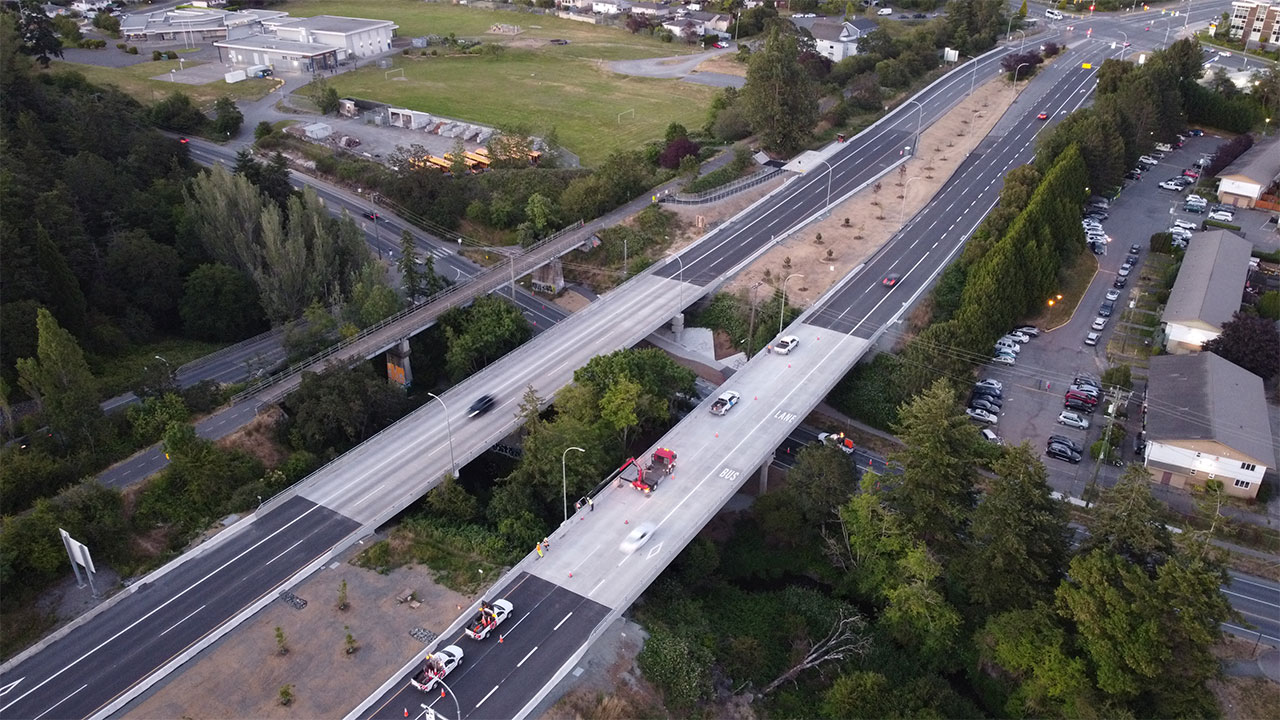
Tetra Tech supervised the BC Ministry of Transportation and Transit’s Colquitz River Bridges project, supporting seismic resilience, transit connections, and traffic continuity on Highway 1.
Challenge
The two Colquitz River Bridges are located along Highway 1 within a busy urban transportation corridor in Victoria, British Columbia. The project required bridge widening, seismic upgrades, drainage upgrades, and roadway improvements while maintaining traffic flow through complex staging and traffic management. As part of the province’s South Island Transportation Strategy, the project also supported dedicated shoulder bus lanes between Tillicum Road and the Admirals-McKenzie interchange in each direction.
Solution
Tetra Tech provided the structural project supervision team for the BC Ministry of Transportation and Transit, supporting bridge rehabilitation and highway widening along Highway 1. Our team oversaw contract administration, quality assurance, surveying, and dispute and change management.
The bridge improvements involved extensive structural modifications, including new foundation piles, additional girders, cantilevered deck extensions, and seismic upgrades. The project also included bridge deck repairs, drainage and utility upgrades, and paving to accommodate the widened bridges and surrounding roadway infrastructure.
Tetra Tech supported the project’s quality and traffic management requirements and provided proactive support for changes and delays. These services helped manage the construction schedule, costs, and quality while Highway 1 remained in service. Together, they supported the project’s safety, resilience, and transit objectives.
Benefits
- Improved seismic resilience of two Highway 1 bridges
- Provided dedicated bus-on-shoulder lanes used by more than 300 buses daily
- Maintained traffic through staged construction
- Extended the service life of existing structures
- Enhanced inter-regional transportation connections