

There is little serious disagreement that without carbon capture, utilisation, and storage (CCUS), the global targets for net zero and limiting warming to 1.5oC by 2050 are impossible to meet. The Energy Information Administration (EIA) estimates that 650 million tonnes (Mt) of CO2 storage capacity will be required per year by 2030 to be in line with their sustainable development scenario, with capacity reaching 5,266 Mt/yearr by 2050 and 9,533 Mt/year by 2070. As the technology and infrastructure to capture CO2 become more economically viable, the availability of places to permanently store it becomes crucial.
CO2 storage, enhanced oil recovery, and the oil and gas industry
The USA’s oil and gas industry has used CO2 for many decades to enhance oil recovery (EOR). Paradoxically in today’s setting, using ‘produced’, rather than captured, CO2 from accumulations such as the Jackson Dome, McKelmo Dome, Sheep Mountain, Bravo Dome, and Doe Canyon. In recent years, however, industry has begun to utilise CO2 that has been captured as a by-product of fossil fuel combustion, gasification, or other industrial processes.
Only a brief trawl through the literature reveals that opinion is sharply divided as to whether the utilisation of CO2 in EOR is carbon-negative or carbon-positive in terms of overall emissions, and it is not the purview of this paper to discuss this argument further. However, even assuming that the Clean Air Task Force view in 2019, based on data from the International Energy Agency, that EOR using CO2 is carbon-negative and removes net carbon emissions from the atmosphere, the amount of ‘storage’ is small when compared to direct sequestration into a depleted natural gas reservoir. Both options are dwarfed by the storage potential of deep saline formations.
Geological storage options
Both depleted oil and gas reservoirs and deep saline reservoirs offer potentially viable CO2 storage solutions, primarily for complementary reasons. The likely performance and, therefore, the attractiveness of these two types of geological storage will be influenced principally by their containment potential, both in terms of volume and ability to ‘seal’ away the CO2 for considerable periods of time, and their injectivity potential. Both principal controls on the attractiveness of any given storage site are subject to different degrees of uncertainty depending on the nature of the storage (depleted vs deep saline).
Comparative benefits of storage in depleted and deep saline reservoirs
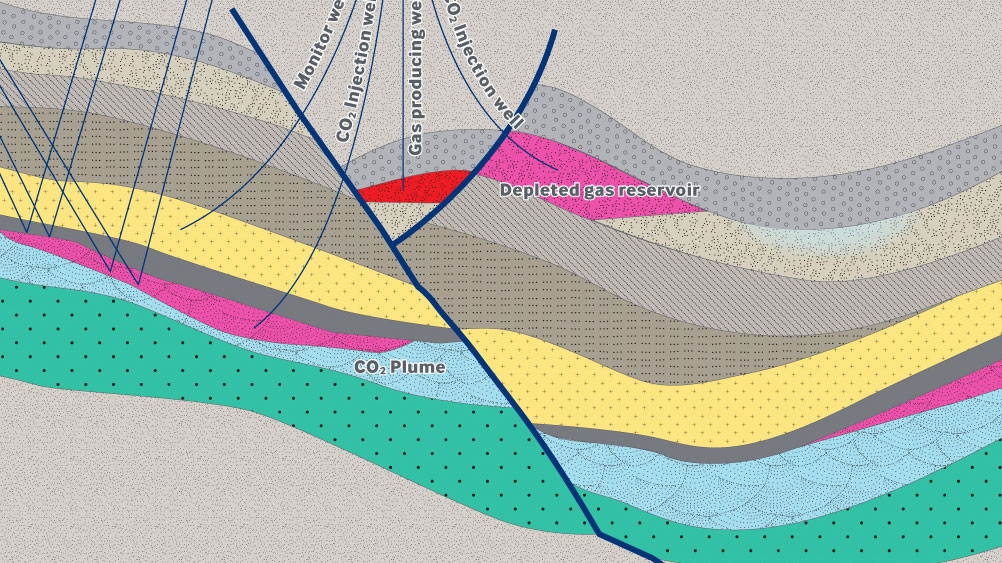
In general terms, depleted reservoirs usually benefit from a significant amount of geoscience and engineering historical performance data in addition to containment and storage having been proved (i.e. a ‘trapping’ mechanism that has been proved to seal a ‘pressurised’ fluid and a pore volume that is accessible to fluids), particularly in the case of a depleted gas reservoir. An additional attractiveness is sometimes promoted based on the ability to “re-use” existing infrastructure such as pipelines, processing facilities and wellbores that might provide a “value-add’ scenario by extending the life of an ageing or yet to be abandoned oil and gas field.
Further, at first sight, one of the most significant advantages of a depleted field is the combination of an initially low pore pressure which, in theory, makes injection easier, together with knowledge of the initial pressure which was mechanically contained by the reservoir and seal. This leads to an ability to ‘re-pressurise’ to those initial conditions with a high degree of confidence that the mechanical seal will hold. However, this perceived advantage has its limits and can quickly become a major disadvantage in certain circumstances which we expand upon below.
Deep saline reservoirs
On the other hand, deep saline reservoirs have an order of magnitude more potential storage potential than depleted oil and gas reservoirs as they tend to be present at a more’ basin wide’ scale, are widely distributed and are generally found in tectonically ‘passive’ areas. They will generally not have undergone structural stress and strain, unlike most depleted oil and gas reservoirs and will frequently not be located close to significant fault systems such as grabens and horsts etc. As such, they are generally regarded as the long-term future of CO₂ geological storage.
Saline aquifers are also better suited to monitoring and tracking the movement of the CO₂ plumes using seismic techniques, borne out by the Equinor’s success over many years at Sleipner. Whereas, in depleted gas fields, the presence of residual hydrocarbons can have a significant adverse effect on the abilities of seismic monitoring to identify the CO₂.
However, most deep saline reservoirs suffer from a paucity of geological and engineering data due to a lack of previous commercial interest. This creates a greater range of uncertainty on such issues as containment (e.g. geomechanical properties in both the reservoir and the overlying ‘seal’, ‘flow-unit’ continuity and lateral extent) and storage (e.g. injectivity and storage efficiency).
As a result, it is likely that considerably more data acquisition and modelling (and therefore cost) will be required to reduce risk and uncertainty to a satisfactory level of understanding such that actual permitting for injection may be granted. Further, in many cases, the wells may be considerably deeper than many conventional oil and gas wells (longer drilling times and cost), and pressures at the reservoir are more likely to be high (though likely not over-pressured compared to the hydrostatic gradient).
This can have the obvious impact of pushing up the overall initial development cost at the early stages of a potential project, making it less commercially attractive even though the successful use of these potentially huge storage volumes is probably essential to meet society’s ambitions on limiting climate warming in the near term.
Depleted oil and gas reservoirs
Therefore, given the above, might it be reasonable to assume that depleted oil and gas reservoirs will be the prime targets for early storage projects? The answer is “perhaps”, in that there are a number of factors that might make depleted oil and gas reservoirs a little less attractive than at first glance.
In contrast to wells that will be specifically ‘designed’ for CO2 injection (commonly known as Class VI), wells designed for oil and gas production (commonly Class II) may not have suitable materials such as cement type and, to a lesser extent, casing steel, to withstand the corrosive nature of the potential formation of carbonic acid. Along similar lines, the age of the existing infrastructure may make it less than ideal for handling the high pressures that are likely to be required for efficient transportation of CO2. Also, in simple terms, the likely number of penetrations, particularly in early exploration and appraisal wells, increases the number of potential leakage points, especially if the plugging and abandonment (P&A) procedure followed for such wells was not well documented.
Probably the key factor in whether a depleted reservoir will be a good candidate for CO2 storage is actually one of the very things that was initially cited as a potential “pro” in our earlier section—lower pressure.
One potential downside of lower pressure is the potential for the original porosity and permeability of a reservoir to have been reduced due to the loss of supporting pressure and fluid, resulting in compaction. This could significantly impact the reliability of injectivity efficiency calculations if the work is based on original conditions, which now no longer exist.
Read more about the pros and cons of depleted reservoirs in carbon capture and storage.
Connect with us. Reach out to our offshore energy experts.