
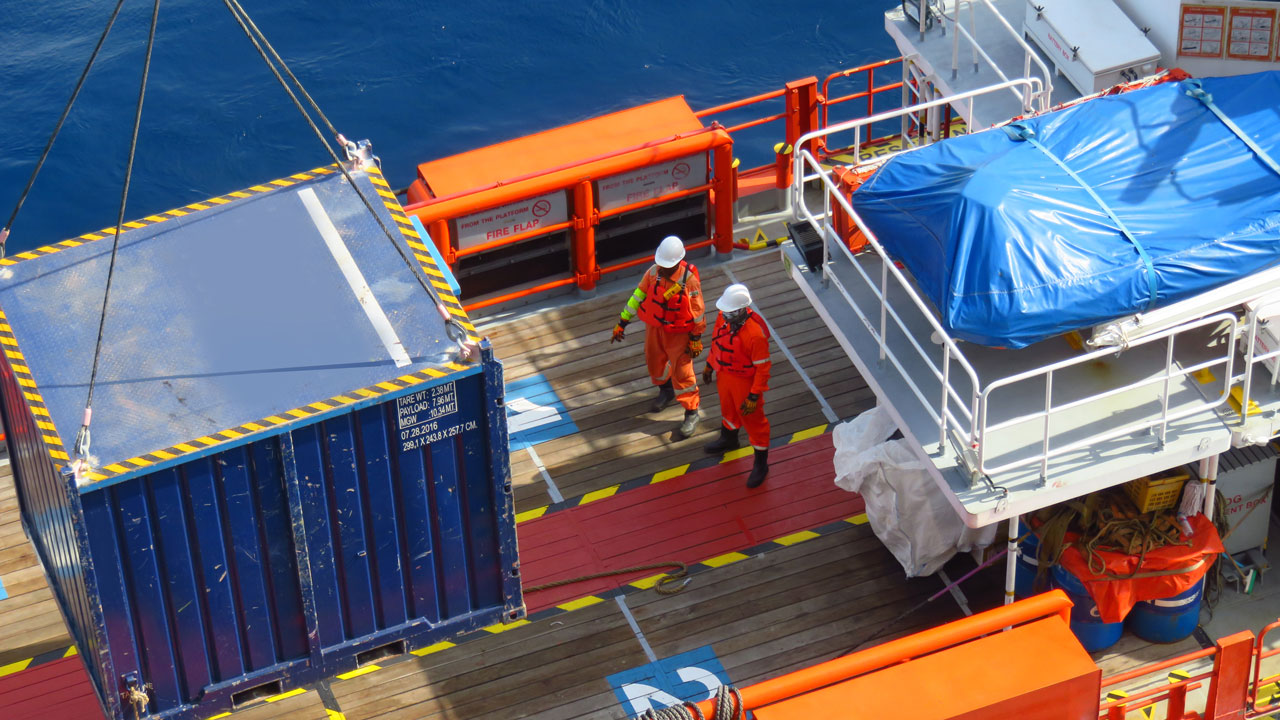
Tetra Tech’s Paul Woodason, health, safety, and environment senior operations manager, supports a wide variety of projects for offshore energy clients.
In this article, Paul explains the safety concerns and potential hazards that offshore energy clients should be mindful of when moving heavy loads between vessels.
Regulations clearly state that lifting equipment be sufficiently strong, stable, and suitable for the intended use, and an appropriate factor of safety against failure be built in. Similarly the load, and anything attached to it, must be of adequate strength.
Additional dynamic forces are also at play when moving pallets offshore, in comparison to a building site or factory where generally only static forces apply. Using specialised lifting equipment, while safe for indoor and on land, may become unsafe when used offshore.
Definitions
- Static force: If a load is lifted very slowly, gradually accelerated, then slowed down and stopped, it will remain “static”. In other words, the effect of load on the equipment used for lifting, doesn’t become more than the weight of the load.
- Dynamic force: It’s a fact that a large proportion of lifting gear used offshore is subjected to shock loading. The effect of shock loading is to increase the weight of the load on the crane, and therefore on the lifting gear used – this load is said to be increased “dynamically”.
In offshore conditions, loads are affected by the combined movement of the vessel and the hoist motion of the crane. This can produce severe shock loads which means everything between the load and the vessel is subjected to “shock”, including the lifting gear, which in turn can increase the load by as much as three times its original weight, and may well produce loads which exceed the proof load of the lifting gear.
To identify the risks associated with lifting operations on vessels, the Management of Health & Safety at Work Regulations 1999 requires a competent person to carry out a ’fit for purpose’ risk assessment.
Tetra Tech has over a dozen competent persons who are trained to evaluate the:
- Types, weights and shapes of loads being lifted
- Risk of these loads falling or striking a person or other object and the subsequent consequences
- Risk of the lifting equipment failing or falling over while in use and subsequent consequences
One of the commonly observed unsafe practices is the transfer of pallets rigged with slings. This is of particular relevance to oil rig platform supply operations and has been banned for many years in areas such as the North Sea.
To transfer palletised loads safely, they should be placed in containers and lifted onto the deck of the rig, platform or vessel. These pallets are then removed from the containers by fork lift truck or trolley. On smaller vessels unable to lift 20ft containers complete with stores, scaled processes emulate industry standards, for example, a 10ft half height container may offer a safer option.
Keeping people safe while performing routine operations such as moving loads between vessels is paramount. At Tetra Tech, our independent competent person auditors, who are trained to understand vessel specific safety requirements, will identify unsafe practices to reduce risk to people and equipment, and they’ll provide advice on best practice risk mitigation strategies.
We work with clients to identify and mitigate safety risks so they can bring oil and gas to market safely – making complex easy.
Connect with us. Reach out to our offshore energy experts.
About the author

Paul Woodason
Paul Woodason is a health, safety, and environment (HSE) senior operations manager in Tetra Tech’s specialist offshore energy business.
With more than 40 years of experience, Paul manages our HSE operations and marine assurance group, overseeing more than 100 associate consultants. He has developed our services to include marine assurance, emergency response services, and our core provision of HSE management for land and marine seismic surveys and offshore renewables projects.
Paul has a degree in applied physics and spent 20 years working offshore as observer and party chief for SSL and WesternGeco, managing marine seismic surveys in the U.S., West Africa, Europe and Southeast Asia.