
On this ground-breaking carbon transport and storage project, we are supporting Northern LightsJV with acquiring baseline seismic data using our Osprey software.
About the Northern Lights
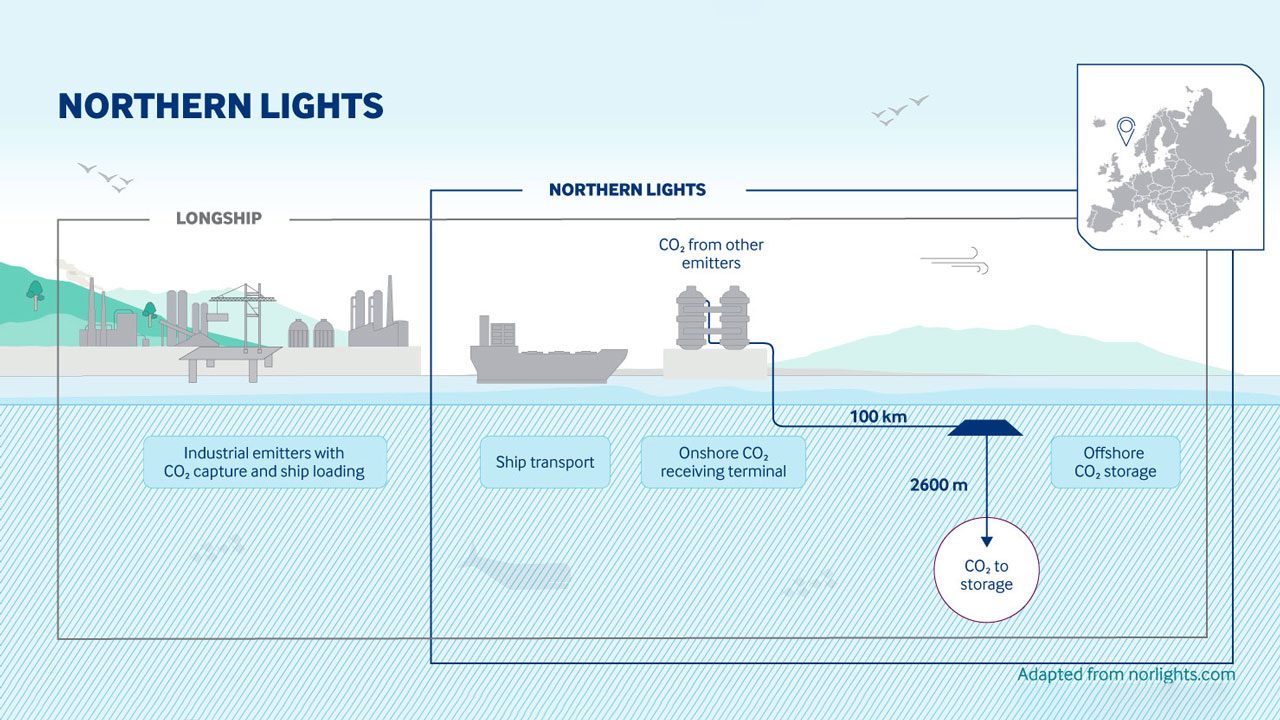
Northern LightsJV is a Joint Venture owned by TotalEnergies, Equinor and Shell and is the transportation and storage component of the full carbon capture and storage (CCS) value chain initiative by the Norwegian state called “Longship”. The project’s first phase will be completed in mid-2024, with an initial capacity of up to 1.5 million tonnes of CO2 per year. The Northern Lights infrastructure is open to third parties and will deliver carbon transport and storage solutions as a service. Northern Lights holds Exploitation License 001, the first license for CO2 injection and storage in subsea reservoirs on the Norwegian Continental Shelf.
Monitoring for safe carbon storage on CCS projects
CO2, once captured, compressed and transported, can be injected into subsea reservoirs, usually depleted wells or saline reservoirs. Many pilot projects, such as the Sleipner CO2 storage project – running since 1996, have stored CO2 underground for decades. However, the right geological conditions must be present.
Once CO2 is injected into a subsea reservoir, it must be closely monitored to understand how the injected CO2 is causing geological changes in the reservoir or the well. For example, in the presence of water, CO2 forms carbonic acid that can cause severe corrosion to the infrastructure. Migration paths in the upper layers of geology that trap the CO2, can be formed by poor well construction or geological faulting.
The first step in instituting a CCS monitoring plan is to establish a baseline survey of the reservoir by acquiring 3D seismic data. Then subsequent surveys are taken so any changes in the reservoir or trapping layers can be detected and interpreted, and the CO2 plume development can be modelled.
Optimising 4D seismic data acquisition
Seismic survey design for 4D seismic interpretation must take a pragmatic approach that combines geophysical and logistical considerations. The quality of data is paramount, and at the same time, data collection costs must be efficiently managed. Tetra Tech has a solid track record of 4D seismic survey optimisation and had previously provided Equinor with expertise on the Sleipner CO2 storage project. We were selected to support Northern Lights on the seismic data acquisition for the baseline survey on this important project.
Before the survey, Tetra Tech optimisation specialists used Osprey, proprietary software, to model different acquisition options. The model considers the multiple infield simultaneous operations (SIMOPS) while the survey occurs. In the Norwegian North Sea, the location of the Northern Lights project, there are many shipping vessels and multiple construction projects in development.
Once in the field, the specialists use the optimised plan and Osprey software to assist with the daily management of the operation, making adjustments as required. The optimisation specialist communicates with other vessels so that everyone is up-to-date and working safely.
The planning of the baseline survey is critical. If the seismic data acquisition is inefficient, there are possible impacts on the subsequent surveys concerning data quality and project costs.
Tetra Tech is excited to be supporting the seismic data acquisition that will be used to develop the underground storage of CO2 for the Northern Lights offshore storage. We recognise that CCS is an essential part of the energy transition and are eager to see this project move forward.
Connect with us. Reach out to our offshore energy experts in the UK and Europe.
The project featured in this article was undertaken by RPS, A Tetra Tech Company and originally published on RPSgroup.com. In March 2026 RPS rebranded to Tetra Tech.