

North American electric utilities face an expanding range of resilience risks and Tetra Tech is helping them invest intelligently to strengthen resilience while maintaining affordability.
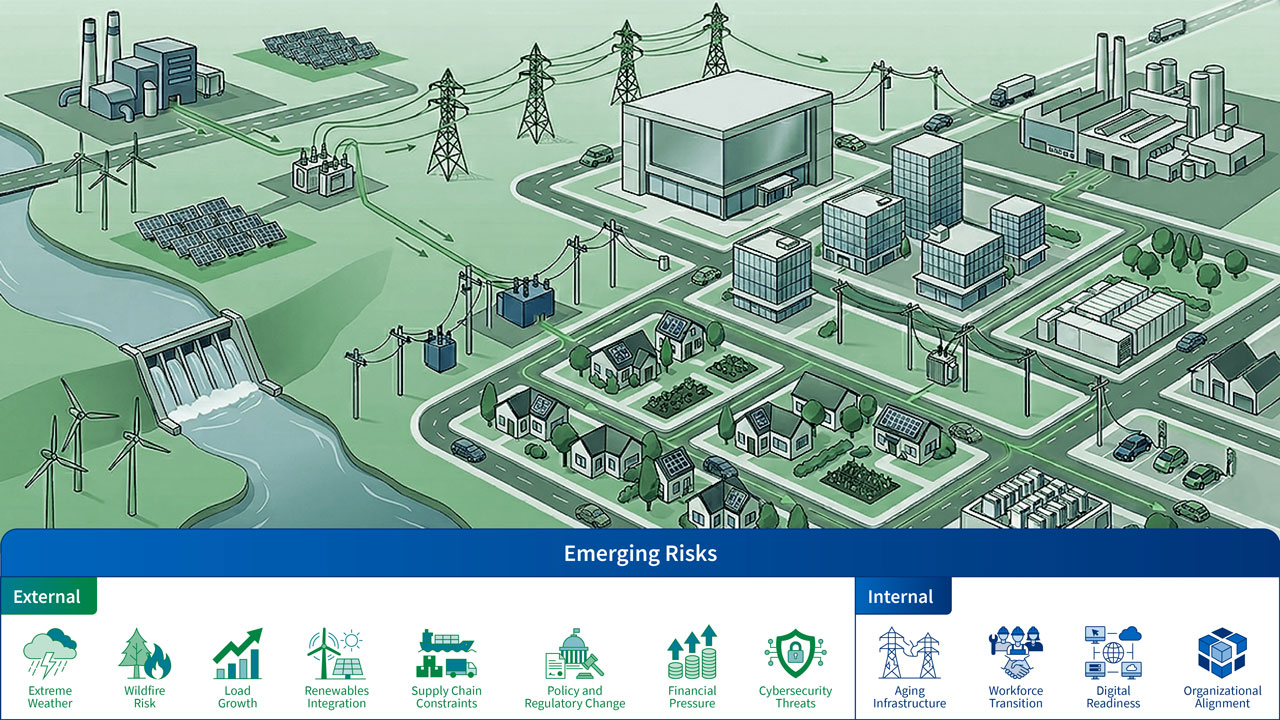
Resilience is a utility’s ability to anticipate, withstand, adapt to, and recover from disruptions while continuing to provide safe, reliable, cost-effective service. North American electric utilities face an expanding range of resilience risks. While some—extreme weather, rapid load growth, and changing resource mixes—are comparatively familiar, others are more subtle. Organizational structure, workforce capacity, and digital readiness also affect resilience. Compounding the challenge, external and internal risks increasingly interact in ways that amplify vulnerability, creating systemic risks across assets, people, processes, and technology that utilities were not designed to manage. At the same time, growing sensitivity to rate increases places additional pressure on utilities to strengthen resilience while maintaining affordability.
Addressing these challenges requires a more integrated perspective. Rather than evaluating risks in isolation, utilities must understand how vulnerabilities and dependencies interact across the enterprise. A structured, evidence-based approach to resilience management helps utilities identify where risks are concentrated, which interventions will have the greatest impact, and how initiatives should be prioritized and sequenced over time. This approach supports more informed decision-making and helps utilities invest with precision, threading the needle between affordability and investments that meaningfully reduce risk.
With an evidence-based framework, resilience planning is more than a justification for spending. It becomes a disciplined investment strategy that directs limited resources where they matter most while providing a clear, defensible rationale to regulators, boards, and customers. Translating that philosophy into action requires a structured process that connects risk identification, investment prioritization, and long-term planning.
To support this process, Tetra Tech applies a structured methodology that moves from enterprise-wide assessment to targeted investment planning. The framework evaluates resilience holistically across infrastructure, operations, workforce, and digital systems, helping utilities understand interdependencies and align investments with real-world risks and performance outcomes. The methodology follows a series of interconnected steps: benchmarking and industry scanning, gap analysis, prioritization and sequencing, targeted deep dives, and roadmap development (see figure for additional detail). Together, these steps provide a transparent, evidence-based process for identifying vulnerabilities, evaluating resilience options, and developing phased investment plans.
Resilience planning model
Benchmarking and Industry Scan
Assess current resilience performance against industry benchmarks and peer utilities while reviewing existing programs to establish a clear baseline
Gap Analysis
Identify gaps between current performance and target benchmarks through a transparent, collaborative evaluation process; assess and integrate ongoing resilience initiatives.
Prioritization and Sequencing
Work with stakeholders to prioritize initiatives based on risk, impact, and constraints to develop a phased, multi-year approach.
Actionable Recommendations
Develop detailed strategies and implementation plans to address high-priority resilience gabs in the near term (<5 years) and longer term (5-20 years).
Resilience Roadmap
Deliver a comprehensive, actionable roadmap outlining initiatives, timelines, and investment pathways, and fostering a culture of resilience.
The result is a practical roadmap that links resilience objectives to measurable risk reduction, operational improvements, and defensible investment decisions. By aligning resilience planning with operational realities, affordability considerations, and enterprise-wide priorities, utilities can strengthen resilience in a way that is both effective and sustainable over the long term.
Building Resilience: What Leading Utilities Do Differently
- Treat resilience as a leadership priority, not just an engineering function
- Align engineering, operations, IT/OT, finance, and workforce teams around a shared framework
- Invest in data quality and evidence before committing capital
- Maintain clear visibility into asset condition, risk, and consequences of failure
- Use scenario-based planning to prepare for a range of possible futures
- Sequence investments with discipline to maximize impact per dollar spent
- Establish a clear line of sight from risk to investment to outcome
- Communicate decisions in a way that is understandable and defensible to regulators, boards, and customers
Download the full version of this two-part white paper to learn more.
Explore related solutions
Resilience planning model
Benchmarking and Industry Scan
Assess current resilience performance against industry benchmarks and peer utilities while reviewing existing programs to establish a clear baseline
Gap Analysis
Identify gaps between current performance and target benchmarks through a transparent, collaborative evaluation process; assess and integrate ongoing resilience initiatives.
Prioritization and Sequencing
Work with stakeholders to prioritize initiatives based on risk, impact, and constraints to develop a phased, multi-year approach.
Actionable Recommendations
Develop detailed strategies and implementation plans to address high-priority resilience gabs in the near term (<5 years) and longer term (5-20 years).
Resilience Roadmap
Deliver a comprehensive, actionable roadmap outlining initiatives, timelines, and investment pathways, and fostering a culture of resilience.
Benchmarking and Industry Scan
Assess current resilience performance against industry benchmarks and peer utilities while reviewing existing programs to establish a clear baseline
Gap Analysis
Identify gaps between current performance and target benchmarks through a transparent, collaborative evaluation process; assess and integrate ongoing resilience initiatives.
Prioritization and Sequencing
Work with stakeholders to prioritize initiatives based on risk, impact, and constraints to develop a phased, multi-year approach.
Actionable Recommendations
Develop detailed strategies and implementation plans to address high-priority resilience gabs in the near term (<5 years) and longer term (5-20 years).
Resilience Roadmap
Deliver a comprehensive, actionable roadmap outlining initiatives, timelines, and investment pathways, and fostering a culture of resilience.
Resilience Planning Model
Benchmarking and Industry Scan
Assess current resilience performance against industry benchmarks and peer utilities while reviewing existing programs to establish a clear baseline
Gap Analysis
Identify gaps between current performance and target benchmarks through a transparent, collaborative evaluation process; assess and integrate ongoing resilience initiatives.
Prioritization and Sequencing
Work with stakeholders to prioritize initiatives based on risk, impact, and constraints to develop a phased, multi-year approach.
Actionable Recommendations
Develop detailed strategies and implementation plans to address high-priority resilience gabs in the near term (<5 years) and longer term (5-20 years).
Resilience Roadmap
Deliver a comprehensive, actionable roadmap outlining initiatives, timelines, and investment pathways, and fostering a culture of resilience.