
Tetra Tech’s Purshotam Juriasingani, emerging contaminants expert, discusses the challenges and considerations for scaling up innovative technologies for PFAS treatment.
This is the third in a three-part series exploring innovative approaches for the treatment of PFAS and scaling up emerging technologies.
Why is the ability to scale a treatment technology important?
PFAS treatment technologies should demonstrate consistent and reliable performance beyond the laboratory setting. Field implementation requires technology that can scale effectively across diverse site conditions, while maintaining treatment efficiency and cost-effectiveness. Scaling up also helps build confidence in the technology and supports the path toward commercial deployment. Additionally, the scalability of PFAS treatment technologies will determine the cost of a full-scale system, compliance, schedule, and long-term liability.
How is Tetra Tech supporting the scale-up of PFAS destruction technologies?
Tetra Tech teams are working with our clients and federal partners to implement field demonstrations of innovative PFAS treatment technologies. These demonstrations help evaluate real-world performance, address operational challenges, and determine the viability of broader deployment. Our goal is to transition promising technologies from pilot scale to full-scale applications.
What types of technologies are being tested for scalability?
Our emerging contaminants experts are supporting the scale-up of three emerging PFAS treatment technologies:
- Electron beam (eBeam) technology for destruction of PFAS in soils and sediments
- Ultrasound technology for mineralizing PFAS in high-concentration aqueous media
- In situ flushing for subsurface soil remediation using specialized amendments
Each technology is undergoing tailored testing to evaluate effectiveness, operational requirements, and field adaptability.
How do we evaluate the scalability of PFAS technologies?
Testing protocols vary based on the waste matrix, treatment technology, and research strategy. Key considerations include contaminant concentration, site conditions, co-contaminants, and energy requirements. Pilot testing allows us to identify limitations, optimize system design, and collect data necessary for technology validation.
Can you provide examples of current field demonstrations?
Electron Beam (eBeam) Technology
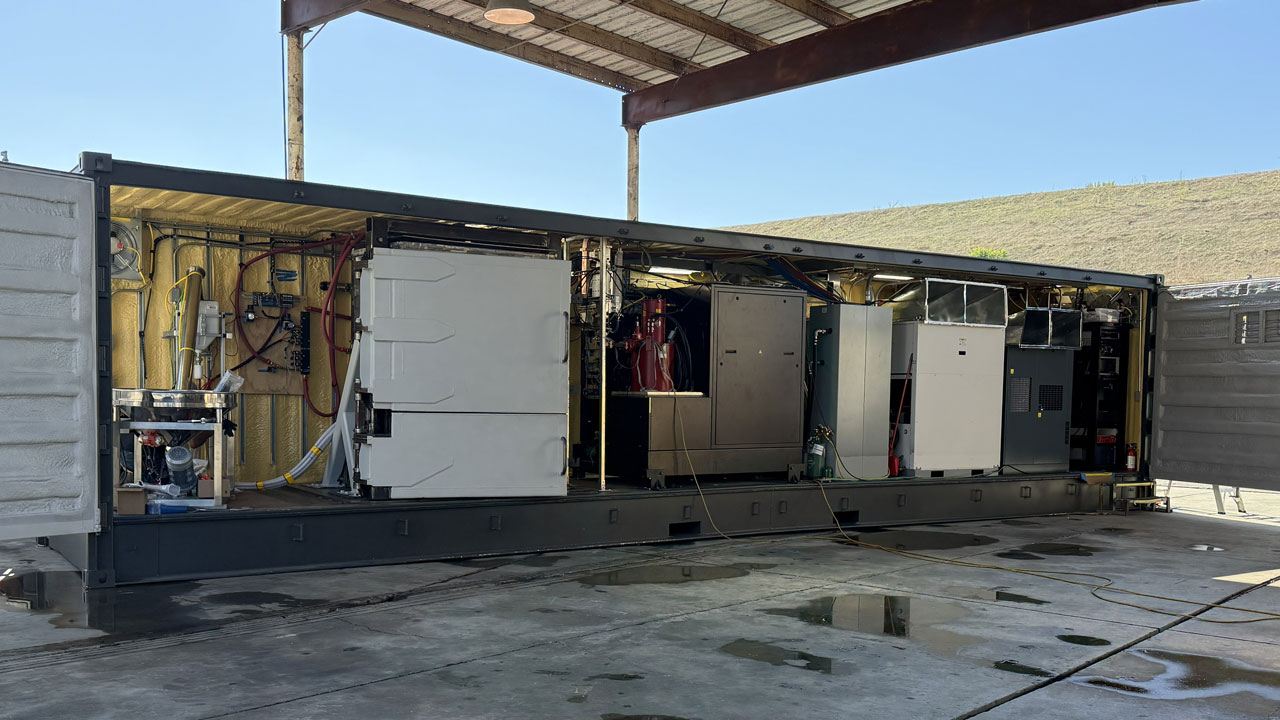
Tetra Tech is collaborating with the U.S. Department of Defense’s Environmental Security Technology Certification Program (ESTCP) to develop and test a mobile eBeam treatment system for PFAS-impacted soils and sediments. Initial research has shown greater than 99 percent destruction of PFAS in solids. The mobile unit has been designed and fabricated for on-site testing at candidate DoD sites to evaluate its performance in the field.
Ultrasound Technology
In partnership with the Air Force Civil Engineer Center (AFCEC), Tetra Tech has designed, fabricated, and demonstrated ultrasound technology for the treatment of high-concentration PFAS in aqueous media. This approach uses ultrasound-generated cavitation bubbles to create localized plasma conditions—resulting in the mineralization of PFAS into fluoride and carbon dioxide. The bulk solution remains at ambient temperature and pressure. The study demonstrated that ultrasound technology can be effective for the destruction of PFAS in AFFF-impacted groundwater with >1,000 ng/L concentrations during a field demonstration, furthering our understanding of this technology. The most effective test demonstrated 96 percent destruction for long-chain PFAS and 87 percent destruction for short-chain PFAS, with total PFAS destruction (including precursors) calculated to be 91 percent.
In Situ Flushing Technology
Tetra Tech has also been awarded a project by ESTCP to demonstrate a novel in situ flushing approach for PFAS-impacted subsurface soils. This technique involves injecting an aqueous food grade and biodegradable amendment solution into the source zone to mobilize PFAS compounds, which are then extracted for treatment or disposal. This method is based on principles similar to surfactant-enhanced aquifer remediation and is designed to reduce contaminant mass in place with minimal disturbance.
What are the next steps for these technologies?
As field demonstrations continue, we are gathering critical data to assess long-term performance, system scalability, and site applicability. These insights will help inform regulatory decisions, optimize treatment strategies, and guide full-scale implementation. Ultimately, the goal is to provide our clients with a robust suite of field-proven PFAS treatment options.
Read more from Purshotam about innovative approaches for the treatment of PFAS and scaling up emerging technologies.
About the author

Purshotam Juriasingani
Purshotam Juriasingani is a vice president who leads Tetra Tech’s research and development for emerging contaminant treatment technologies.
He has more than 28 years of professional experience in environmental program management and remediation technology innovation, design, and implementation. Purshotam has extensive experience with thermal, physical, biological, and chemical treatment technologies and leads Tetra Tech’s program to develop proof-of-concept treatment technologies and processes for PFAS compounds. He also works as a principal investigator for U.S. Department of Defense projects focused on site demonstration of PFAS treatment technologies.
His experience includes leading multi-location, cross-functional teams and applying innovative remedial technologies for the treatment of both conventional and emerging contaminants in soil, groundwater, and sediments. He holds a Bachelor of Science in civil engineering, Master of Science in environmental engineering, and is a registered professional engineer in Texas and Montana.