
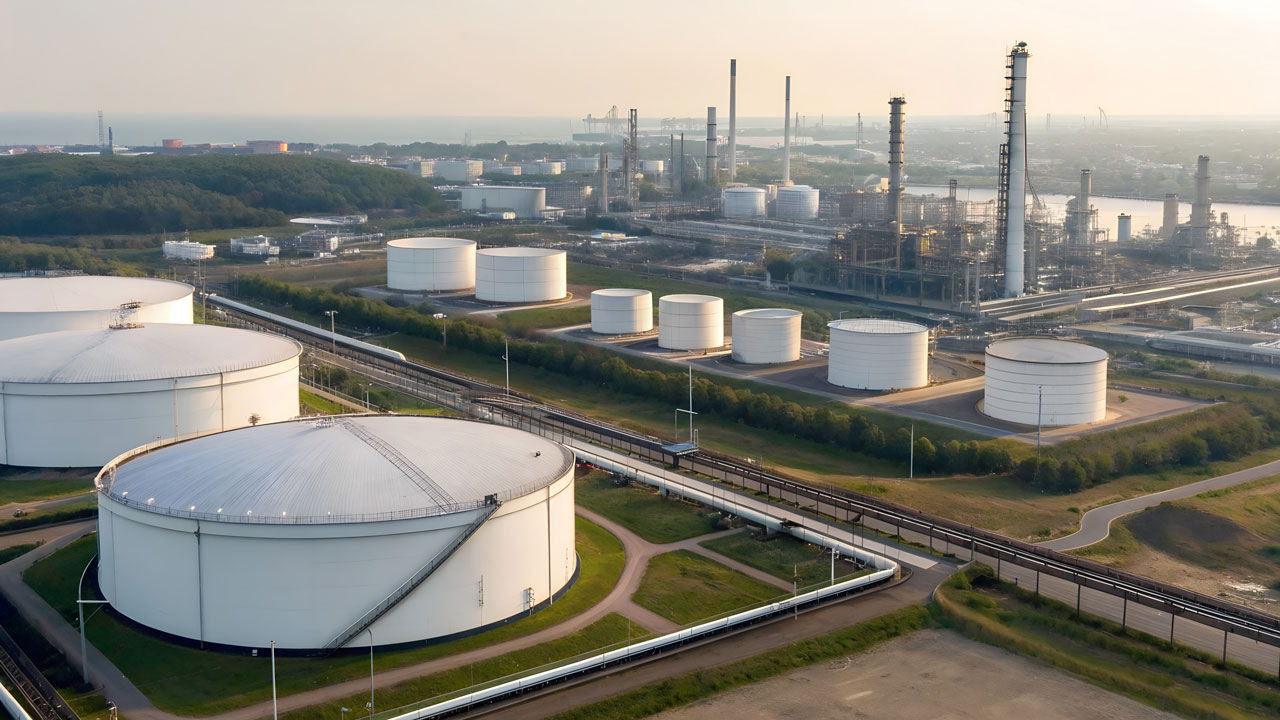
Tetra Tech supported the UK’s first facility of its kind to recover resources from waste and generate renewable electricity via innovative enzyme and anaerobic digestion technologies.
We provided consultancy services from concept design, planning, detailed design through to construction on this traditionally procured scheme; presenting the project to the planning committee that successfully approved the scheme at the first time of asking.
The plant comprises a waste bunker with overhead crane, reception hall, pre-sorting areas, bioreactor hall, sorting and loading halls as well as associated offices and control room.
External facilities include an anaerobic digestion tank farm, CHP engines, main stack, gas flare, ancillary storage sheds, a water treatment plant plus weighbridges and parking.
Challenge
This was a world first project with no precedence to rely on as an example. This combined with a challenging delivery programme and budget resulted in a number of wider challenges including:
- Tight timescale: The programme was driven by the need to achieve first operation by April 2017 in order to gain Renewables Obligation support
- A heavily constrained site
- Challenging programme and budget
- Client’s insurers requirements
Assisting with the development, coordination, and delivery of an innovative and complex process solution for a company whose vision is a world that runs entirely on green energy.
Solution
We prepared the environmental permit application alongside the planning application, Environmental Impact Assessments (EIA), ground investigation, and animal by-products application. The documents were fully prepared in-house drawing on efficiencies with the EIA and included permit specific assessments and plans including a Fire Prevention Plan, Application Site Condition Report, detailed Odour Management Plan and H1 Assessment. As the first plant of its type to be permitted under the Environmental Permitting Regulations (EPR), careful consideration was given to presentation of the BAT Assessment for the Ørsted enzymatic technology.
Additionally, we were appointed to provide the architectural and engineering design of the facility. To meet the extremely challenging programme and budget, we developed a close working relationship with the client and technology designer to provide an innovative solution. Concrete from the previous site structures was crushed and reused for capping and sub-bases wherever possible to reduce clean material being brought to site.
A building envelope solution was selected that reacted directly to the internal environment with single skin cladding used to large areas of the un-heated process spaces in order to reduce the embodied carbon within the envelope. Natural lighting was also introduced into the process halls to reduce the need for artificial lighting and the energy required to produce it without introducing additional heat gains.
A site wide drainage solution was developed that separated the site into zones, provided containment and attenuation in order to prevent potential contamination and reduce run-off into the existing local watercourse.
We used Building Information Modelling (BIM) and software including Autodesk Revit and Navisworks during the design process. This helped co-ordinate the facility with the complex MHP and process equipment through the use of clash avoidance and further assisted in developing a collaborative working environment. The use of BIM was also used to help streamline sustainability by saving time, improving efficiency, enhancing design, reducing errors, and providing a quantifiable opportunity for the building’s lifelong environmental impact to be lessened in line with sustainable construction’s whole philosophy.
The EA issued the environmental permit in September 2017, leaving a matter of months to discharge pre-operational conditions and allow the facility to be brought into operation. Due to the tight timescale we worked closely with the EA to secure advance notice of likely conditions to ensure rapid discharge of conditions could be achieved.
We subsequently supported Ørsted in the preparation of the commissioning phase plan, accident management plan, and energy efficiency plan and provided support to regularise minor technical changes to the design prior to its operation. In conjunction with our in-house design and engineering team we also discharged the pre-operational condition confirming all containment structures at the site had been designed and constructed fully in accordance with BAT and CIRIA guidance.
With our support Ørsted discharged all pre-operational conditions in time to achieve its operational deadline.
At a glance
Client
Ørsted
Location
Northwich, England
Services
Architecture, building services, CDM principal designer, civil engineering, environmental impact assessment, fire engineering, planning, public consultation, structural engineering
The project featured in this article was undertaken by RPS, A Tetra Tech Company and originally published on RPSgroup.com. In March 2026 RPS rebranded to Tetra Tech.