
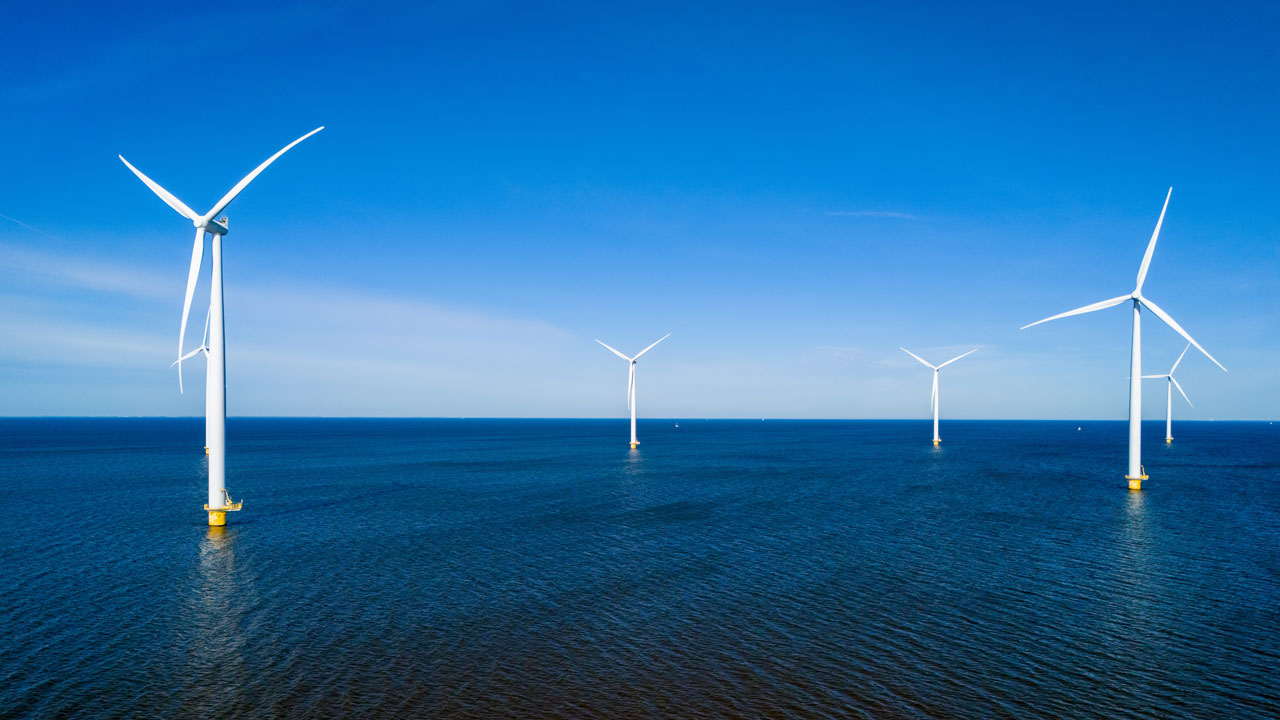
Tetra Tech’s Kevin Linnane and Daisy Chamberlain, marine ecologists, explain how marine net gain and the drive for marine biodiversity will affect offshore wind development from the leasing and design stages.
A new drive for environmental enhancement is changing the way offshore wind projects are leased and designed. In this article, we look at how this global trend could affect your development, with examples from the North and Celtic Seas.
Recently, there has been growing interest in encouraging marine biodiversity as part of offshore wind projects. It may seem strange to describe something so valuable as a ‘trend’, but it’s clear that this activity is gaining pace – and that the impetus comes from developers’ internal stakeholders as well as policy makers.
Although you’ll hear many similar terms to explain the central concepts of marine net gain (MNG), they’re not interchangeable. Although MNG isn’t yet a mandatory requirement, here we are using this term to cover the following two aspects:
- Environmental enhancement refers to how we work to improve the marine environment regarding the quality and/or extent of habitats. It focuses on how to encourage nature recovery by protecting species and habitats and reducing the pressures affecting them. Examples include habitat creation or restoration, improving water quality, and reducing disturbance. This might be done directly, in partnership with a nature conservation body, or via paying into funds where available.
- Nature-inclusive design refers to design elements integrated into marine infrastructure that benefit biodiversity. Examples are cod tubes, which provide shelter for juvenile cod, and structures that encourage seabed-dwelling species, like these ExoReefs being trialled at the META Project.
Developers may also commit to both environmental enhancement and nature-inclusive design, as in the plans Noordzeker recently announced for their “nature inclusive wind park” at IJmuiden Ver Alpha off the Netherlands.
Why address marine net gain?
The UK is one country where marine net gain is not yet written into legislation, with definitions and parameters still under discussion. However, in the UK and internationally, this looks set to become a formal requirement as the offshore wind and other industries’ use of the marine environment increases. Currently in the UK, the expectation from regulators and nature conservation bodies is that Marine Net Gain initiatives are put forward voluntarily by developers before this becomes a legal requirement. Our consultants are already answering requests for MNG support on our existing projects and a growing number of bids are including biodiversity statements.
Nature enhancement also contributes to corporate sustainability goals, biodiversity targets and satisfying ESG policies, as well as satisfying stakeholder expectations. The developer Orsted has been one front-runner, stating:
We call on other renewable energy developers to set ambitious biodiversity goals backed up by credible action .. We call on policymakers to include stronger biodiversity criteria in renewable energy tenders, incentivising all developers to focus on value and not just short-term cost for this already highly cost-competitive energy technology.
This means now is the time to prepare a project to define its MNG plans instead of catching up at a later stage in the project.
Biodiversity and the offshore wind auction stage
In the EU, various Member States are asking for evidence that satisfies ‘non-price criteria‘’ in renewables auctions. Rather than focussing on price and support costs, these qualitative criteria include sustainability, innovation, and market integration.
The UK’s Leasing Round 5 in the Celtic Sea includes a similar initiative. The Crown Estate say: “We are seeking to accelerate progress towards a net positive outcome for biodiversity and improved resilience of marine ecosystems through Round 5.”
As part of their bids, Celtic Sea developers will need to include plans to demonstrate how they will create environmental and social value. Tetra Tech worked with The Crown Estate to produce a ‘longlist’ of interventions that bidders could take forward, but developers have the choice about what to include. The absence of formalised targets or measures of success also gives developers flexibility.
A key point is that evidence of intent to benefit the environment could increasingly be tied to agreement for lease. As such, consideration of environmental value is likely to need to be considered at an earlier stage than the onshore ‘equivalent’, Biodiversity Net Gain, which is usually undertaken during the consenting phase of onshore projects.
What MNG means for offshore wind developers
Here are four practical tips on how you can start considering marine net gain for your project:
1) Costs and time
Planning for MNG means budgeting for related costs and time upfront. You’ll want to understand how much investment is required at the consenting stage as well as later when consent is achieved (the point when external funding decisions are made).
The answers will depend on your site, the local environment and the type of survey work needed, which may inform the specific nature-inclusive design measures to be deployed. There is potential for economies of scale through scaled deployment of these measures across your site or as technologies become cheaper as they get more established. At a regional scale, there are opportunities for wider strategic environmental enhancement projects, which may include multiple partners to deliver large scale benefits to the marine environment.
2) MNG is not BNG
Marine biodiversity considerations can’t be compared like-for-like with onshore biodiversity net gain (BNG). Taking England as an example, BNG legislation has been in place for several years, with established metrics for measuring gains. These balance potentially adverse impacts on biodiversity as a result of a development with enhancement and biodiversity offsetting. The marine environment is much larger and more dynamic, so quantifying positive impacts on very different areas—from sandy sediment to estuarine salt marsh or nearshore oyster reefs—is complex. This means that MNG regulations may evolve to allow marine enhancement that happens both at the development site (in the form of nature-inclusive design) and further removed from the project site via contribution towards projects that provide wider environmental value.
3) Futureproofing
Some projects will proceed with caution (and uncertainty) as regulations evolve. At Tetra Tech, our marine consenting and environment team take the approach of finding appropriate and proportionate solutions that are most likely to deliver measurable benefits to the marine environment, while including flexibility to allow for future-proofing. We also monitor changing legislation to support our clients as they proactively plan for their projects.
4) A change in mindset
One of the most exciting things about this trend is the change in outlook. In the past, the environmental impact assessment (EIA) process has been focussed on potential adverse impacts and mitigations, whereas MNG aims to create benefits. This subtle change in thinking provides many positive opportunities such as aiding in the recovery and restoration of the marine environment while building developers’ reputations for taking a responsible and proactive approach.
Support for marine biodiversity measures and assessment
Tetra Tech helps clients define their habitat creation, restoration, and enhancement programmes and provide related support, project management and surveys. We work across the entire asset lifecycle, including preparations for lease applications and projects already in the planning stage.
In particular, we look to connect clients, partners and providers working in this space. We have built relationships with a wide network of stakeholders to support MNG provision and nature-inclusive design. We are also actively involved in supporting the development of new interventions, providing the environmental baselines and expertise to ensure ecological information is considered in the designs themselves.
Tetra Tech explores key challenges for developers. Our offshore wind consultancy team provides solutions and insights for developing in the Celtic Sea.
Connect with us. Reach out to our offshore energy experts in the UK and Europe.
About the authors

Kevin Linnane
Kevin Linnane is a senior associate director for the marine ecology and habitat regulation assessment team, working on energy and infrastructure projects in the UK and internationally.
Kevin is a project manager and marine ecologist with over 14 years’ experience as a marine consultant. He provides consenting/permitting support and advice to projects including offshore wind and renewables, oil and gas, interconnectors, aggregates, and ports and harbors. He has a PhD in marine ecology and specialist knowledge of the effects of marine activities on benthic and fish ecology.
Kevin is a skilled Environmental Impact Assessment (EIA) practitioner in support of Development Consent Order and marine license applications. Kevin also has considerable expertise in Habitat Regulation Assessment. He has excellent working relationships with a range of stakeholders including consenting authorities across the UK and Statutory Nature Conservation Bodies during all stages of consenting and post-consent. This has included developing appropriate management and mitigation measures to minimize effects of marine activities and industries on the environment.

Daisy Chamberlain
Daisy Chamberlain is a benthic ecology specialist and environmental consultant, passionate about delivering projects for the benefit of the environment while achieving positive outcomes for clients.
Daisy has an MSc in Marine Biology from the University of Southampton, UK. She has over 12 years’ experience working in environmental consultancy, providing technical input on UK projects spanning estuarine, coastal, and offshore environments, from intertidal to deep sea regions. She also plans and delivers marine environmental surveys.
Daisy is experienced in project and program management, interpretive reporting, and the assessment of the impacts, including Ecological Impact Assessments (EIAs), Habitats Regulations Assessment (HRA), Water Framework Directive assessments, and Marine Protected Area assessments, marine license applications, and works licenses.
The project featured in this article was undertaken by RPS, A Tetra Tech Company and originally published on RPSgroup.com. In March 2026 RPS rebranded to Tetra Tech.