

Tetra Tech’s experts explore the pros and cons of depleted versus saline reservoirs for carbon capture and storage.
Our previous article on this topic ended with a comment on the potential downside of lower pressure leading to reduced porosity and permeability in a depleted oil and gas reservoir. This could significantly impact the reliability of injectivity efficiency calculations if the work is based on original conditions, which now no longer exist.
The injectivity gap
CO2 can be highly volatile in terms of its ability to pass from its gaseous to liquid or super-critical phase—together known as the “dense phase”—across the typical range of temperature and pressure differences that would be seen in common wellhead and bottom-hole conditions, particularly in the case of a gas-expansion drive for the original production.
Even if conditions in a wellbore are controlled such that the CO2 is maintained in its dense phase, a sudden drop in pressure (to less than 1,071 psi – the critical pressure) at the reservoir interface can lead to a transition to a gaseous state within the bottom-hole region or the near-wellbore formation. When this happens, a phenomenon analogous to the Joule-Thomson cooling effect (when a gas expands freely) occurs and can lower the frac pressure of the near-wellbore reservoir significantly, risking geomechanical failure.
This cooling can also lead to the formation of hydrates which may impact injectivity efficiency. One way to manage this in the early stages of injection into a strongly depleted reservoir, is to maintain the CO2 in its gaseous state from the wellhead to the reservoir until the reservoir has ‘filled’ sufficiently to re-pressurise such that CO2 will convert to its super-critical phase.
However, the optimum condition for transporting CO2 to the wellhead is in its dense phase and therefore, specific pressure management facilities will be required at the wellhead to convert the dense phase to a gaseous phase ready for injection.
This facility will, by definition, only be required for a relatively short period of time (i.e. until the reservoir pressure has been restored to something in excess of 1,071 psi) before extensive modifications to the surface equipment are required to switch to a dense phase operation from source to reservoir, adding potentially significant cost.
The ideal scenario for geological storage of CO2
Perhaps the ideal scenario for selection of a depleted reservoir, therefore, is one where the original reservoir drive was pressure supported by an active aquifer, for instance, such that the ‘abandonment’ pressure is either close to initial conditions or recovers to something above the CO2 critical pressure of 1,071 psi.
It is generally accepted that active aquifer support for a gas reservoir reduces recovery efficiency as water breakthrough is generally terminal for gas wells. However, since pressure is likely to be maintained above 1,071 psi, such a well could be ideal for CO2 injection as a secondary utilisation with the benefit of having a detailed understanding of initial conditions etc.
Injection can therefore occur whilst further ‘exploration’ of nearby (preferably underlying) deep saline reservoirs can be undertaken to provide a long-term sink which can take advantage of the original infrastructure that was connected to the initial gas field and could be designed with a dual purpose in mind from the outset.
The pros and cons of depleted versus saline reservoirs in carbon capture and storage (CCS)
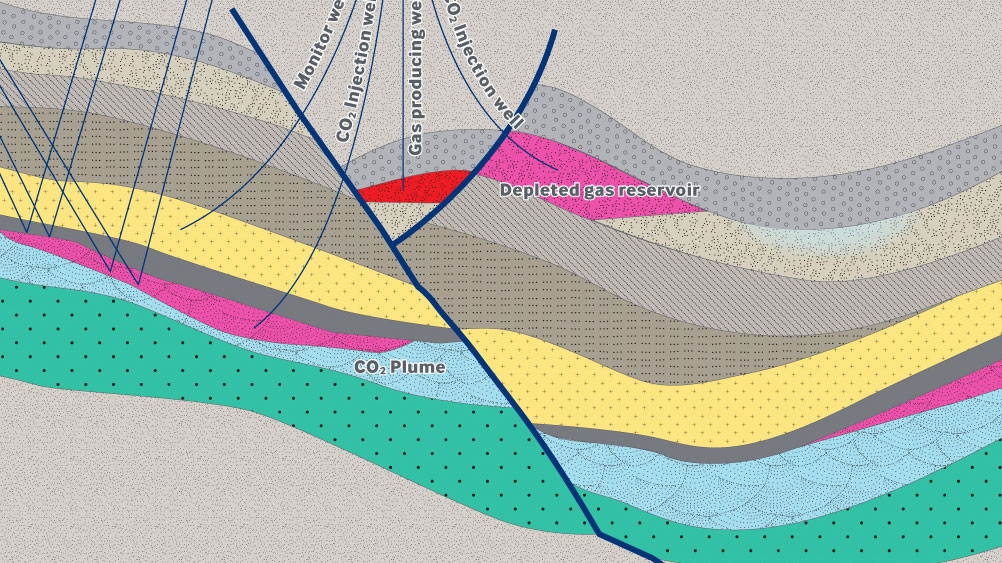
A phased lifecycle approach
In conclusion, both reservoir types have different risk profiles and degrees of uncertainty, and each has a role to play in a successful CO2 sequestration scenario. Indeed, it could be envisaged that the most successful long-term CO2 storage projects will employ a combination of both through a phased lifecycle. If you have questions about carbon capture and storage (also known as sequestration), please contact our team.Read more about the pros and cons of depleted reservoirs in carbon capture and storage.
Connect with us. Reach out to our offshore energy experts in the UK and Europe.