
Dr. Sharon Richardson, director of artificial intelligence (AI) at Hoare Lea, A Tetra Tech Company, explores how AI is accelerating change across the built environment and how emerging technologies, such as AI and robotics, can be applied in practice while working within the real-world constraints of engineering and delivery.
Innovation is often framed as possibility. New technologies, bold ideas, and future visions dominate the conversation; but in the built environment, innovation quickly meets the realities of regulation, cost, risk, legacy systems, and skills constraints.
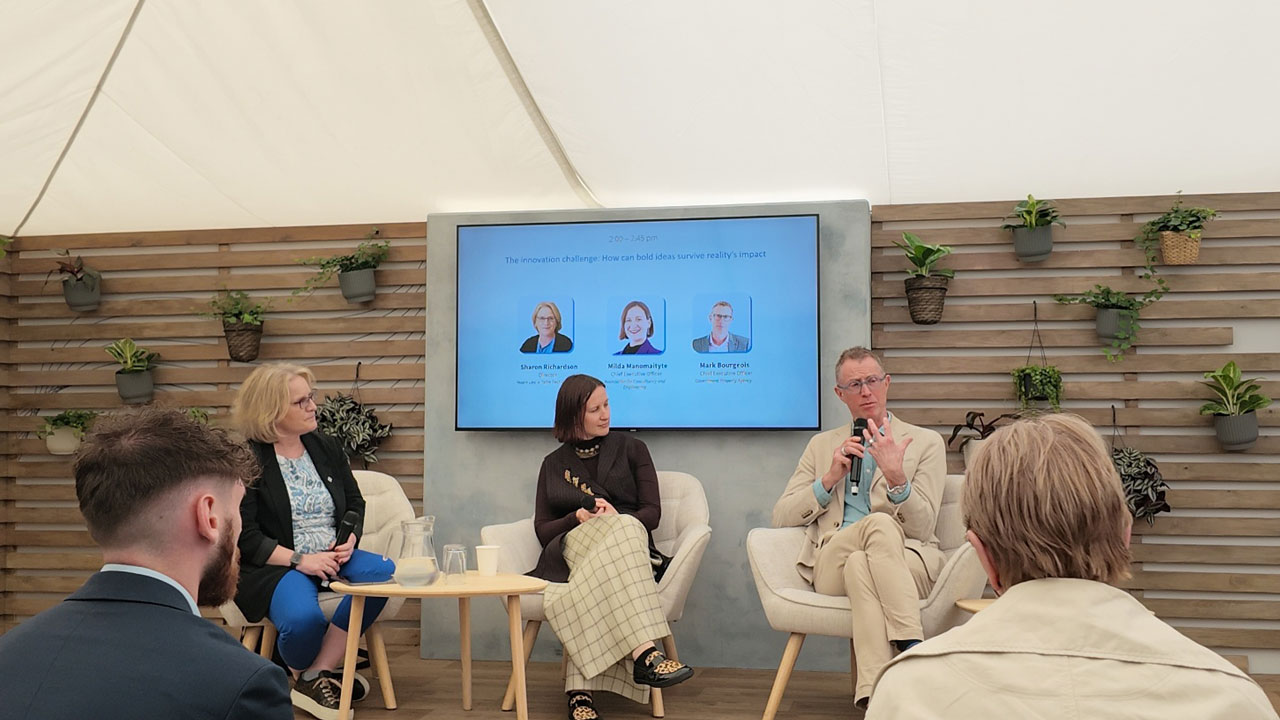
Tetra Tech’s panel discussion on innovation and innovation challenges at UKREiiF, the UK’s leading real estate and infrastructure investment forum, aimed to explore not just how innovation reshapes our industry, but how bold ideas survive once they encounter the practical challenges of delivery.
Our panel members Milda Manomaityte, chief executive officer of the Association for Consultancy and Engineering, and Mark Bourgeois, chief executive officer of the Government Property Agency, brought perspectives from industry leadership, policy and delivery. What emerged was not a single view of the future, but a shared recognition that innovation is as much about people and systems as it is about technology.
Looking beyond the immediate
We began by looking beyond what feels immediately achievable. One idea that’s gained media attention is the concept of placing data centres in space. It is a provocative idea, reflecting very real pressures. Demand for data is rising, energy consumption is increasing, and infrastructure is under strain.
This discussion was quickly grounded by the fundamental challenges this poses. Radiation exposure risks data integrity, maintaining infrastructure remotely introduces complexity, the logistics of transporting equipment are significant, and the reliance on robotics would be unavoidable.
Yet the value of the discussion was not in determining whether this will happen—it was in how it challenges our thinking. Extreme ideas often force us to rethink what we consider normal. In this case, how we power, locate, and operate infrastructure here on Earth.
Designing for a dual world
Milda Manomaityte introduced an important perspective early in the session. The future of infrastructure is not solely about serving people. Increasingly, it must accommodate machines.
Simple examples highlight this shift. Delivery robots navigating our streets or automated systems interacting with infrastructure are no longer theoretical. But Milda’s point went further. We already know how to design accessible environments for people, yet we have not consistently delivered them. So why are we prioritising changes to support machines when human accessibility challenges remain unresolved?
This reframes innovation. It’s not only about capability, but about values: who benefits, who is included, and how those priorities are set.
Dr. Sharon Richardon, Director for AI at Hoare Lea, A Tetra Tech Company
The widening gap between pace and process
A consistent theme throughout the discussion was the growing gap between the speed of technological advancement and the systems that support it. Milda highlighted how quickly policy can become outdated. A strategy developed for AI in transport required immediate revision following new technological breakthroughs. The pace of change simply outstripped the process.
This challenge extends across infrastructure, planning, and engineering. While our systems are designed for stability, consistency, and risk management, innovation demands flexibility and responsiveness. Alongside this sits a significant skills challenge. Parts of the industry are still developing baseline digital capability, while at the same time being asked to adopt advanced AI and automation. This creates a disconnect between ambition and delivery.
Governance versus experimentation
As the conversation moved into AI, the tension between governance and experimentation became clear. Milda emphasised the importance of trust in this process. In infrastructure, decisions carry real consequences. Clients need confidence in how AI is used, how outputs are validated, and how risks are managed. Without that assurance, adoption will stall.
Mark Bourgeois offered a different perspective. He argued that too much structure too early can limit innovation. His example of the spaghetti tower challenge—where teams are asked to build the tallest free-standing tower using dry spaghetti, tape, and a marshmallow—illustrated how overthinking and rigid planning often lead to weaker outcomes, while simple experimentation delivers better results. Sometimes the most effective approach is to test, adapt, and learn quickly.
In our sector, tolerance for failure is understandably low. Yet without experimentation, progress stalls and we risk failing future generations. The balance between these two positions is where meaningful innovation sits.
Trust, data, and the human experience
Another dimension explored was how technology could shape the experience of place. Mark raised the idea of using biometric data to inform how buildings respond to occupants. Could environments adapt in real time to improve comfort, wellbeing, or productivity? The potential is clear, but so are the questions. While some see benefits in responsive environments, others are cautious about sharing personal data. Trust is central to this concept and transparency and control are essential.
Milda brought the discussion back to practical value: if technology improves outcomes for people, it has a role. But acceptance will depend on how it is implemented and governed.
The enduring importance of people
Throughout the discussion, Mark returned to a consistent principle—that technology will not replace the need for human connection. Buildings, workplaces, and cities are social environments, and innovation may change how they function, but it does not remove the purpose they serve. People come together to collaborate, solve problems, and create value.
In many ways, the growth of technology reinforces this. As processes become more automated, the importance of human judgement, creativity, and interaction increases.
Innovation is often framed as possibility. New technologies, bold ideas and future visions dominate the conversation. But in the built environment, innovation does not happen in isolation.
Dr. Sharon Richardon
Rethinking skills and careers
One of the most complex challenges we discussed was the future of skills. AI is already reshaping entry-level roles and tasks that once provided early experience are being automated. This risks creating a gap where organisations expect experience without providing a pathway to develop it.
Milda highlighted the tension clearly. Organisations face cost pressures and may default to automation, while individuals struggle to gain the experience they need. The opportunity is to rethink how careers are structured. If routine tasks are removed, there is potential to accelerate people into higher-value roles. However, this requires investment in training, mentorship, and support.
Learning from past decisions
As the session progressed, I brought the conversation back to lessons from the past. Mark reflected on his experience in retail, where large-scale developments were delivered based on assumptions about future behaviour that did not fully materialise. Many of those assets now require significant adaptation.
The lesson is simple. We cannot assume that current needs will define the future.
This has implications for how we design flexibility into infrastructure, how we plan for change, and how we avoid embedding rigidity into long-term assets.
A final reflection
To close, I asked both speakers to suggest one innovation they would like to see in the next five years. Milda pointed to robotic systems capable of inspecting and repairing infrastructure in real time. It is a powerful example of how innovation can improve efficiency, safety, and resilience. Mark suggested an anti-innovation space—environments where technology is removed, allowing people to engage directly without digital distraction.
It was an unexpected but fitting contrast. Innovation is not an objective in itself; it is a means to an outcome. Its success depends on whether it improves how we design, build, and experience our environment.
The critical challenge for clients
We work with organisations that are navigating this complexity every day. They are not seeking innovation for its own sake. They are asking how to integrate new technologies within the constraints they face. That includes cost pressures, regulatory requirements, carbon ambitions, and evolving user expectations.
Our role is to bring together engineering, design, and digital expertise to help make those decisions work in practice. Whether that is creating adaptable buildings, integrating AI into performance strategies, or advising on long-term infrastructure planning, the focus is on delivering solutions that are both forward-looking and grounded in reality.
The most valuable innovation is not always the most visible or the most advanced. It’s the one that delivers meaningful outcomes and stands the test of time
Dr. Sharon Richardson
About the author

Dr. Sharon Richardson
Sharon Richardson is director for AI at Hoare Lea, part of Tetra Tech’s High Performance Buildings Group, where she is shaping the firm’s vision of AI as a catalyst for more sustainable, resilient, and adaptive buildings.
With a PhD in cognitive and socio-spatial data science, and more than 25 years’ industry experience, Sharon brings a rare blend of technical, strategic, and research knowledge to guide the team’s exploration of AI as a transformative force for the built environment.