
Dr. Joseph Sanders explores how our asset management, complex analytics and risk assessment tools can help water companies address the impact of increased flooding and pollution and reduce the risk of asset failure in wastewater and clean water networks.
In the UK, gravity sewers make up the bulk of the network transferring foul and storm flow to treatment. However where pumping is required, stations lift and shift flow in pressurised rising mains, creating a set of challenges unique to wastewater, but not unique to the water industry.
These pumping mains have often been considered a forgotten asset, with historical investment focussing on high profile flooding and pollution schemes, but this perceived under investment in an ageing set of assets could lead to a “bow wave” of failures and a rise in the number of pollution incidents attributable to these bursts. However, bursts and flooding have long been a challenge familiar to the supply of clean water. It is becoming more apparent that significant discharges of chlorinated water into rivers and streams from burst water mains can have significant environmental impact and as such can be considered a pollution incident, so a mechanism and process to establish the consequence of failure and the risk of these pressurised systems is a critical part of future pollution reduction.
So with failures in pressurised assets of all types leading to increases in pollution numbers, Tetra Tech’s asset management, complex analytics and risk assessment tools can support water companies in building knowledge around the likelihood of problems occurring, but also the consequence of failure, enabling targeted proactive intervention to reduce pollution incidents.
Assessing the likelihood of a raising main burst
The prediction of future asset failure is complicated. Strategically, asset deterioration models can provide support for the development of rehabilitation programmes as part of water company business plans, but the move towards predictive performance assessment can give a more proactive strategy for management.
Tetra Tech utilises leading and lagging factors to support our understanding of burst likelihood, examining historical failures, pump performance, and energy use. Our operational teams can increase the confidence in the data associated with rising mains through survey, pressure monitoring, and remote sensing via drone to build knowledge of routes and key assets such as air valves. Long term permanent monitoring can then provide data surfaced in WaterNet™ Pro, allowing performance of monitors to be reviewed live and ‘out of norm’ conditions to be spotted and actioned, reducing the likelihood of pollution occurring.
Determining the impact of bursts
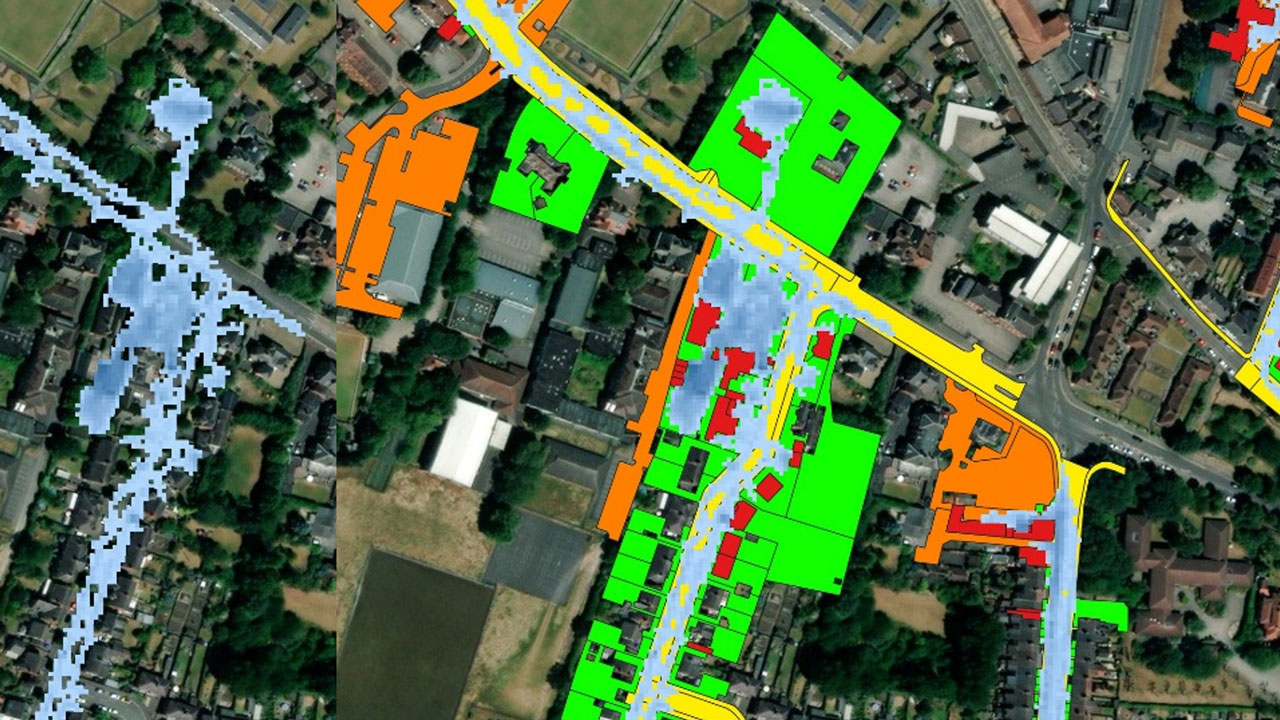
The Tetra Tech PondSIM tool, part of the WaterNet Pro suite, enables a rapid impact assessment of asset failure to be undertaken, determining the consequence of overland flood waters. We have been using this tool to assess the impact of gravity systems through blockage and capacity exceedance, as well as to understand the impact of bursts across the length of rising mains, or at critical control structures in both waste and clean networks such as air valves and hydrants, with both route and consequence visualised in our web portal.
This impact assessment allows the categorisation of flooding impacts to buildings, locations, and surfaces, as well as the pollution impact on watercourses and sensitive sites, using all available categorisation information to determine the severity of pollution impact. With PondSIM allowing time/flow varying inputs, this has allowed for the impact of slow and steady seeping flow to catastrophic burst scenarios, replicating the impact of hundreds of litres per second of water on large impact areas.
Improved investment planning and pro-active response
At Tetra Tech, we are in a better position to understand the consequence of failure of pressurised systems both in wastewater and clean water and using WaterNet Pro to proactively monitor the network in real time, we are able to identify issues before they become pollution problems, enabling pro-active response and investment, avoiding the costly impact of a pollution incident.
About the author

Dr. Joseph Sanders
Joe has over 15 years’ experience working in the water industry as an academic, water company employee, and consultant.
He is our Technical Director and is focused on clean water – in the areas of asset management, leakage, water resources, and network optimisation. He has extensive knowledge of leakage assessment, reporting, and calculation techniques. His experience includes network failure and consequence modelling and developing cost benefit optimisation of water network strategies for both capital and operation interventions. He recently co-authored the UK Water “A Leakage Routemap to 2050”, setting out the needs of the industry for the next 25 years. He is a chartered engineer and water and environmental manager. Joe is a Fellow of CIWEM and sits on their Water Resources Panel.