
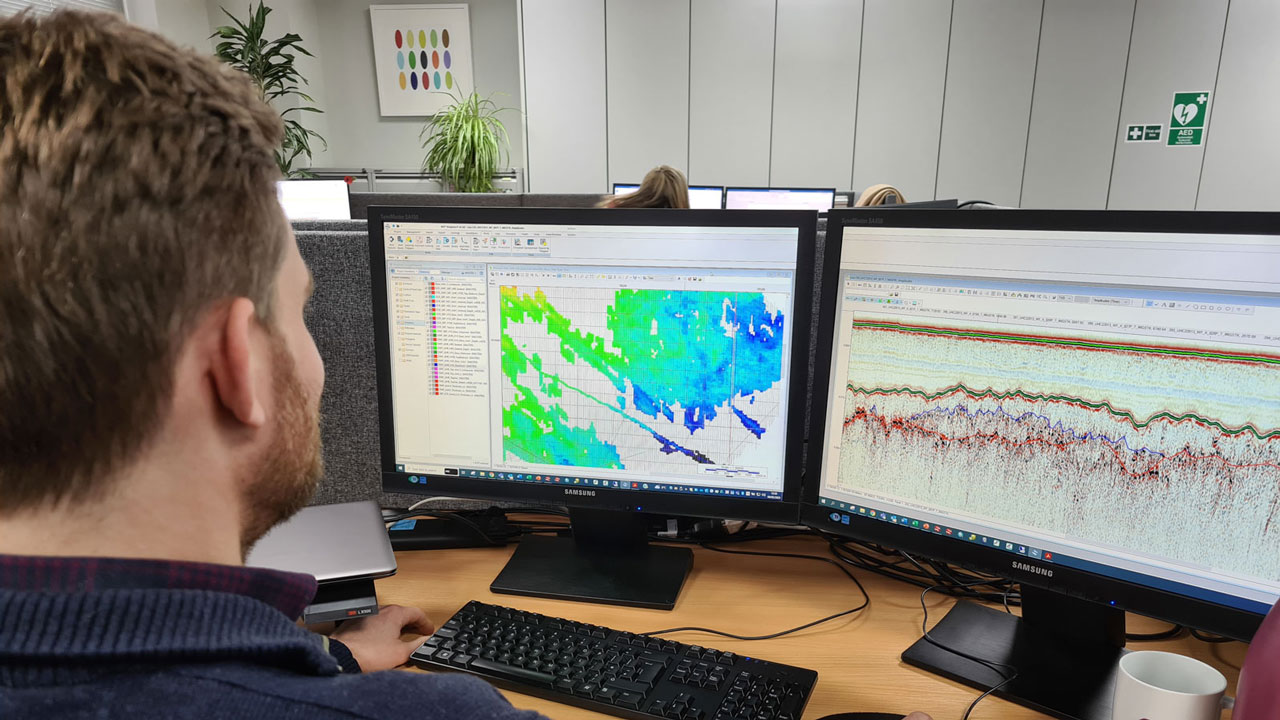
A Tetra Tech geological data study for Australia’s Blue Marlin offshore wind project can be used to support preliminary site risk assessment and design.
Challenge
Geohazard desktop studies are often carried out by interrogating national databases and analysing publicly available information. Unfortunately, much of the data pertaining to this area’s oil and gas developments are proprietary. Publicly available data related to the area was acquired in the period between 1965 and 1990, for which electronic information may not be available. For this study, only a few of the data sets available on the national database were useful and contained data at a suitable resolution for analysis.
Solution
With only limited and legacy geotechnical data available, the Tetra Tech team turned to available seismic data to provide an overview. Where there is enough data coverage, seismic data can also be used to inform understanding of the proposed study area by extrapolating from a different area’s geotechnical information.
We used the available data to construct a ground model of the on-site seafloor conditions. Due to the limitations on specific data for the site, the initial model was not suitable for determining exact soil conditions—an essential piece of information when planning for a stable wind turbine foundation. However, it was sufficiently detailed to present preliminary findings on site risks, and to inform preliminary design.
While the ground model is considered a ‘work in progress’, it will be updated with more detailed analysis as subsequent baseline surveys take place. We have also recommended that our client seeks access to additional geotechnical information from privately held Gippsland coast commercial projects, which we noted during our data search.
Why desktop studies are so important in offshore wind site selection
A robust, data-led assessment of a proposed site is essential to mitigate or de-risk potential constraints. In looking to seismic records for a wider data set, the Tetra Tech team were able to draw on our wide range of in-house specialisms, as well as our decades of offshore energy development experience in Australia and internationally.
The desktop study also underlines the value of gathering accurate, specific data, and the case for data sharing and availability. Although we were able to inform the first stages of the design process, physical site investigations will be essential to gain an even better understanding of the development area, especially given the variable ground conditions known to exist across it—a recommendation we were able to give to our client.
Tetra Tech completed the desktop study in just 21 days. When changes were requested to the proposed area after this time, our team also swiftly carried out reviews and updates to meet our client’s timeline.
At a glance
Client
Vena Energy Australia
Location
Offshore Victoria, Australia
Services
Geological desktop study, preliminary site assessment
Connect with us. Reach out to our offshore energy experts in the UK and Europe.
The project featured in this article was undertaken by RPS, A Tetra Tech Company and originally published on RPSgroup.com. In March 2026 RPS rebranded to Tetra Tech.