

This article explores the complexities of high-level solution development for reducing overflow spills, highlighting the need to consider network headroom, treatment capacity, catchment interactions, and root causes to create realistic, cost-effective plans.
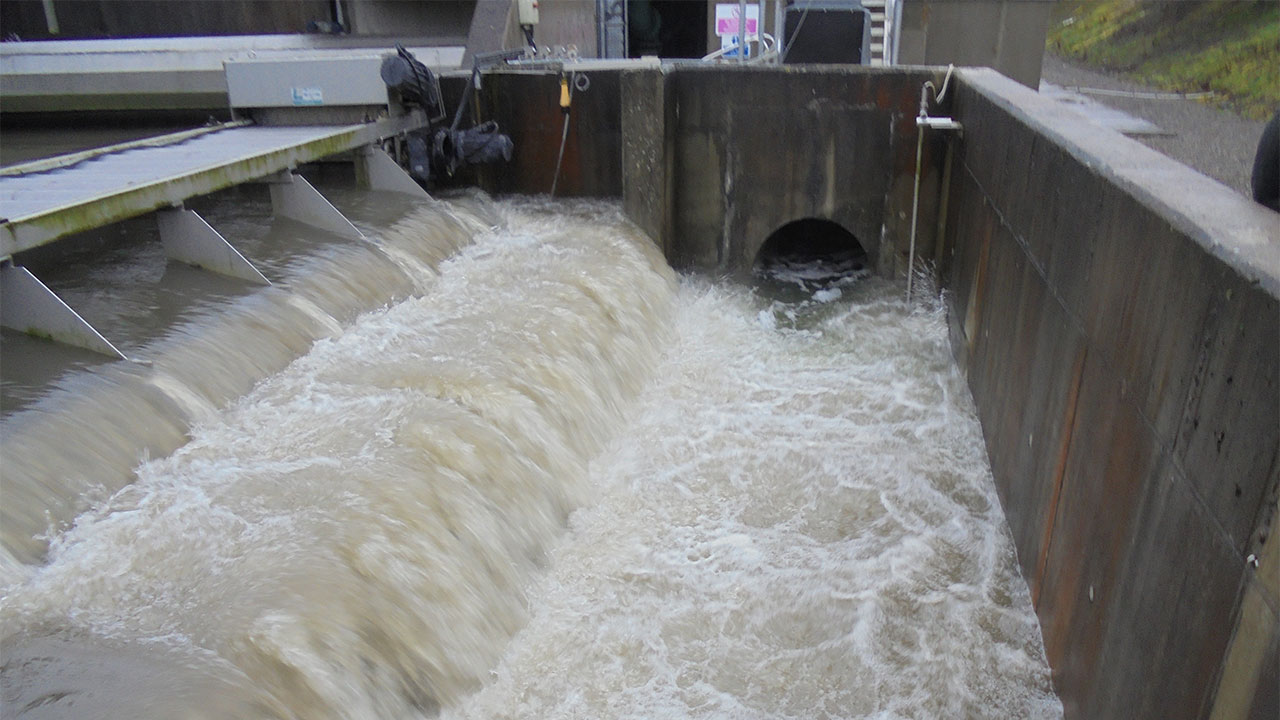
The 2024 Price Review (PR24) defines the projected costs water companies are estimated to incur in AMP8 to deliver Ofwat’s expectations for the 5-year period. These expectations are largely driven by customers’ concerns, climate change and water quality, with significant focus on the reduction of storm overflow discharges. Tetra Tech worked with United Utilities during PR24 to rapidly develop high-level solutions to reduce overflow spill occurrences at sites experiencing frequent discharges. Tetra Tech’s water experts evaluated grey (building storage tanks), blue-green (sustainable urban drainage systems), and hybrid solutions that combine both approaches.
Grey solutions
Typically, grey solutions involve temporarily storing surplus stormwater and wastewater in tanks or piping to regulate discharges during heavy rainfall. In our work for United Utilities, we measured grey storage volumes using model simulations.
Avoiding headroom limitations
When headroom is significantly limited, it poses a critical challenge to the development of a grey solution as it would not be possible to return attenuated flow back into the system. We found that without this consideration, modelled tanks could empty more quickly than what is possible in reality, and it is likely that undersized and under-priced tanks would fail to meet spill targets once implemented. In these instances, hybrid solutions that incorporate nature-based solutions like sustainable urban drainage systems (SuDS) should be maximised to avoid headroom limitations. Increasing network and treatment capacity may also be an option to ensure storage is a viable solution.
Impact of storage tanks on wastewater treatment works
With additional stored volumes at various sites within the network, there is increased pressure on the treatment of these flows that usually would spill to the environment. If the capacity and operation of the treatment works is not considered, this may result in a shift of spills from the network overflows to the overflows at the treatment works. Ideally, catchment-wide risk and the performance of treatment works should be considered as part of solution development to avoid this issue.
Blue-green and hybrid solutions
Impermeable area (IA) reduction via SuDS was calculated through the identification of areas which could realistically be removed and where SuDS systems could be viably installed. In this scenario, we modelled and simulated solutions to understand spill frequency variations.
Retrofitting SuDS into the existing landscape
Retrofitting SuDS to existing impermeable areas to reduce their contribution to the network can occur on a small scale (i.e., the roofs, drives and curtilages of private property). Whilst these features can positively influence a local environment, they introduce potential issues regarding agreements and access to carry out such work, adding length, cost, and complexity to the process. The rate of refusal for this work to be carried out on properties should be accounted for to produce blue-green solutions that are more likely to realise the expected benefits.
The challenges of SuDS-only solutions
Confidence in the connectivity of impermeable areas is important in producing the most reliable SuDS solutions, and surveys would have to be carried out in areas of uncertainty. This would require a significant amount of work and take valuable time, adding pressure to delivery of these solutions. Even with confidence in the connected areas, Tetra Tech found that a very small proportion of solutions tested were able to achieve the overflow reduction target with a SuDS-only scheme. Hybrid solutions utilising both SuDS and traditional storage tanks offered more viable options, however grey-only solutions offered the highest proportion of viable options.

Future considerations
Strategic assessment of hydraulically linked overflows
When multiple overflows require solutions, rather than carrying out assessments on a site-by-site basis it may be beneficial to derive solutions on a more systematic catchment-by-catchment approach. The impact of implementing a solution at one overflow is likely to positively impact any downstream overflows, therefore, by considering multiple combined sewage overflows (CSOs) within a catchment at one time this is likely to produce an overall more efficient and cost-effective solution. Attenuating flows at an upstream site will reduce peak flows received at any downstream sites and may therefore reduce the storage volume required for a tank, or the amount of area to be removed for a SuDS or hybrid solution. There is a limitation to this approach in that it would not be possible to further develop an individual solution without also developing all hydraulically linked solutions synchronously.
Understanding the root cause of spills at individual overflows
An understanding of the root cause of CSO spills allows the smartest and most appropriate solution to be developed. Simplistically, the root causes largely consist of excess incoming flow, the inability to store or treat excess flow, premature spill mechanisms, or the inability to pass forward sufficient flow. For example, if the root cause is excess incoming flow from ground infiltration (GI) then building a tank to attenuate this flow may not be appropriate. An improved solution may be identifying the source of GI and removing or redirecting the flows from this, or if the source cannot be identified then pass-forward capacity of the CSO may be re-evaluated.

Conclusion
For rapid, high-level solutions to frequent overflows, developers should identify root causes, contributing areas, hydraulically linked sites, and treatment and network capacity, and also consider challenges like retrofitting SuDS. The challenges associated with obtaining and compiling this data are considerable, however considering these aspects is likely to result in more viable and efficient solutions and an overall saving in terms of programme time and cost.