
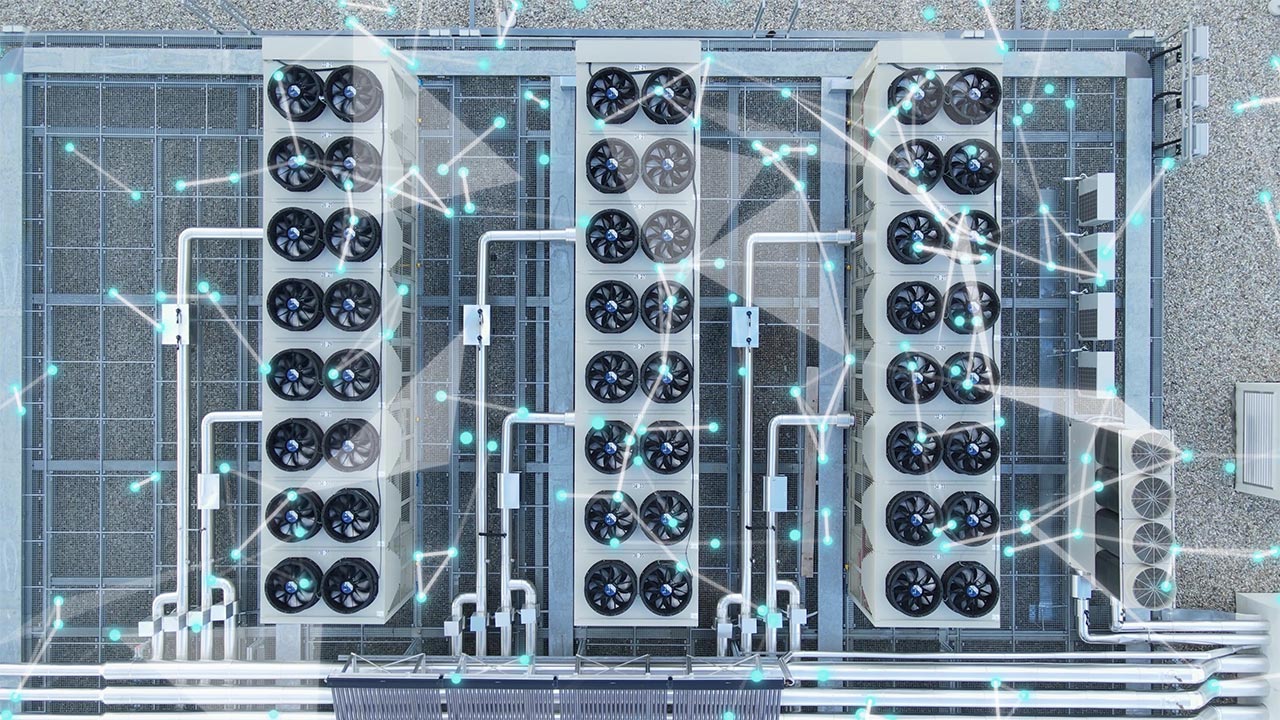
Tetra Tech’s white paper, Sustainable Data Centers: Modeling Water and Power Demands for Cooling, examines how advanced energy modeling can quantify water and power demands for data center cooling across Texas climates.
The rapid expansion of artificial intelligence (AI) and hyperscale data centers is reshaping infrastructure demands across the United States—particularly in Texas. As demand for cloud computing and AI grows, both energy and water use are becoming critical considerations in how and where these facilities are developed.
In 2023, data centers accounted for approximately 4.4 percent of U.S. electricity consumption, with projections indicating that it could grow to more than 10 percent by 2030. In Texas, where data center capacity is expected to grow rapidly, increasing energy demand will also drive additional water use both onsite and at power generation facilities.
This growth has significant implications for water resources. Many data centers rely on evaporative cooling systems, which consume large volumes of water. At the same time, efforts to reduce on-site water use often require greater energy input for mechanical cooling—shifting water demand to the energy sector. These trade-offs extend beyond the facility, as increased energy use can lead to higher water consumption at the point of power generation.
Modeling water and energy trade-offs
Traditional approaches to estimating data center water use rely on annual averages, which can obscure important variations in demand. Tetra Tech’s analysis uses physics-based building simulation to model water and power consumption on an hourly basis, providing a more detailed understanding of system performance.
The study evaluates how climate conditions, information technology equipment design, and cooling system configuration influence demand, with modeling conducted for theoretical sites in Houston and El Paso to represent the range of Texas climates. Results show significant variation in water consumption based on location and cooling technology.
Learn more about how advanced modeling can support sustainable data center development.
Supporting sustainable infrastructure planning
Integrated planning approaches that consider both water and energy demands are essential for sustainable data center development. In water-constrained regions like Texas, understanding these trade-offs is essential for long-term reliability and sustainable development.
Tetra Tech’s unique modeling approach enables developers and planners to evaluate how cooling technologies, climate conditions, and operational factors influence water and energy demand. By simulating scenarios, stakeholders can identify strategies that balance efficiency, cost, and resource availability—supporting more sustainable data center development.
About the author

Michael Weller
Michael Weller is an energy modeling lead in Tetra Tech’s High Performance Buildings Group.
He has more than 15 years of experience modeling energy and water consumption of building systems. He specializes in estimating energy and water demands for data centers to support site selection, infrastructure planning, and cooling systems design.
He also focuses on optimizing existing building operations, analyzing portfolio-wide energy and water efficiency measures, and performing large-scale studies for regulatory or code-making processes. His work helps clients make informed decisions through clear, tailored insights and data-driven analysis.
This article was featured in the Powering Our Future: Reliable Delivery to Meet Real Demand issue of TetraVerse™.