
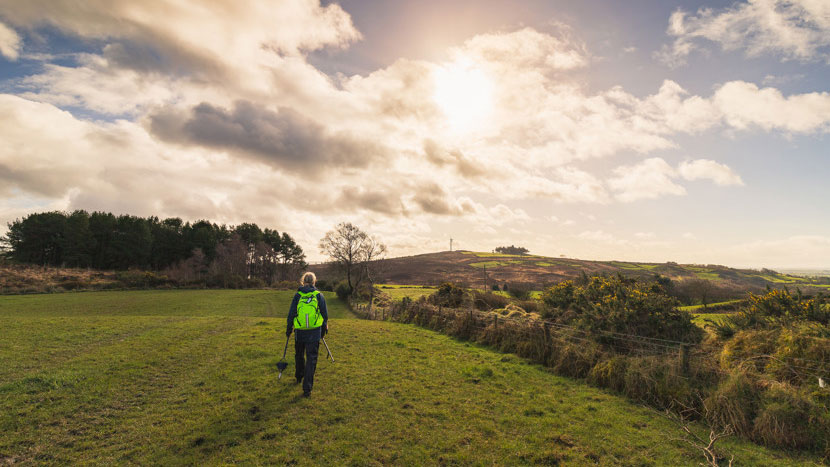
Tetra Tech delivered the largest baseline soil sampling programme in Northern Ireland, collecting field-by-field data from around 700,000 agricultural fields to inform nutrient management and carbon stock estimation.
Over the course of four years, we are collecting soil samples from approximately 700,000 agricultural fields across Northern Ireland and delivering the samples for laboratory testing. The project builds on the mapping and data management expertise our team demonstrated in a pilot scheme completed in 2017/18 where samples were collected from 12,500 fields across the country over three months.
The Soil Nutrient Health Scheme (SNHS) is the largest baseline soil sampling programme ever undertaken to enable efficient and sustainable crop production. The £37 million initiative was launched by the Department of Agriculture, Environment and Rural Affairs (DAERA) and is managed by AFBI.
The scheme offered farmers a free, whole-farm soil sampling and analysis service, which includes soil sample collection and soil analysis, on a field-by-field basis, and access to training from the College of Agriculture, Food, and Rural Enterprise (CAFRE). The results from the scheme will provide farmers a unique baseline of information on essential plant-available soil nutrients, soil pH, and organic matter content.
Farmers are offered training by CAFRE on farm nutrient management and the use of soil analysis results to better plan fertiliser and manure applications.
As part of the scheme, AFBI also gathered Light Detection and Ranging (LiDAR) data for all of Northern Ireland. Farmers were also provided with runoff risk maps for nutrient loss to waterbodies for each field sampled. The scheme aims to improve soil nutrient health, provide a baseline assessment of farm carbon stocks in soils, and contribute to the transition to Net Zero farming in the region.
Challenge
This project was one of the most comprehensive regional soil nutrient sampling schemes to be undertaken globally. While collecting soil samples in each field is a relatively straightforward process, navigating the logistics of managing samplers to deliver on this scale and within time constraints is complex.
Due to its scale and complexity, we adopted a systematic approach to rolling out the project on a zonal basis. Northern Ireland has been divided into four zones, with sampling focused on one zone each year.
A key aspect of the soil sampling and analysis is ensuring sufficient time passes from the last application of nutrients to the fields before taking samples. As a result, most of our sampling was undertaken during the slurry spreading closed season during winter months of November to January each year.
Solution
Our project management team manage recruitment and deliver training for over 250 staff each year of the four-year project, covering key aspects of sample collection and associated quality assurance procedures. The project delivery team comprises soil samplers, a farmer communications team, a warehouse team to scan and pack samples and quality assurance personnel to collect and review samples from soil samplers.
To ensure the safety of soil samplers lone working in rural areas, we employed a lone working app which offered live tracking of samplers in the field, man down and non-movement alerts for soil samplers to use which notified our project management team.
We provided a project farmer communications team to engage with the farmers and collect data relating to the fields to be sampled. Our communications team fed this data into the central database to ensure the samplers were aware of any hazards in the fields and only sampled fields that need to be sampled.
Our Geographic Information System (GIS)/Data Team provided digital management, mapping, and quality assurance for the project. They undertook sample allocation and mapping to simplify the process for soil samplers, developing strategic clusters of fields called allocations which team leaders allocate to each soil sampler to be sampled over a period of two to three weeks. Soil samplers were provided with map data on mobile devices which includes base mapping, field boundaries, optimal W shaped sampling transects, guide sample locations, depth of samples required, and any known hazards.
We’ve adopted a relational database management system to manage and organise live data originating from diverse sources. Central to our data flow and management is our ESRI Enterprise Licence. The four components of ArcGIS Enterprise worked together to provide comprehensive functionality for web mapping, image exploitation, real-time data handling, large-volume batch analysis, and spatial data science. Imagery and machine learning/artificial intelligence (AI) classification algorithms were used to detect fields that may be unsuitable for sampling and analyse GPS data to optimise thresholds and reduce manual checks.
We’ve focused on incorporating robust digital management and control procedures to enable the efficient and accurate sampling of all the required fields within the necessary timeframes and to the appropriate standards. This allowed for reduced sampling times on site, more rapid data validation and increased project transparency for the client.
Our team of quality assurance personnel collected soil samples from samplers in the field, carried out quality assurance checks on GPS data and sample bags, before delivering the samples to our warehouse. Our warehouse team undertook additional checks, scanned and packed samples for transport to an external lab. The lab was then responsible for analysing samples and issuing the analytical results to farmers.
At a glance
Client
AFBI and DAERA
Location
Northern Ireland
Services
Data management, digital mapping, field sampling, project management, quality assurance
The project featured in this article was undertaken by RPS, A Tetra Tech Company and originally published on RPSgroup.com. In March 2026 RPS rebranded to Tetra Tech.