
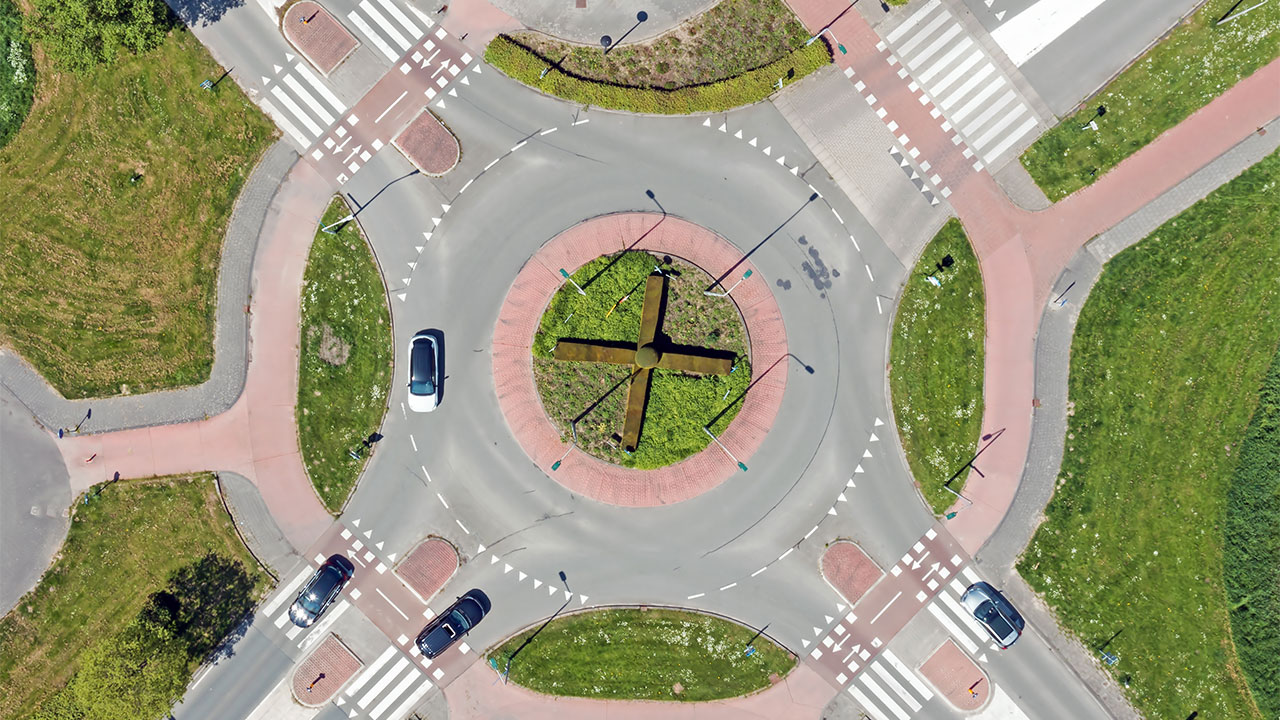
Tetra Tech designed the Church Fields Link Road and cycle network scheme to improve connectivity, sustainable transport and urban mobility.
To facilitate a housing development in Mulhuddart, Dublin 15, a new link road from an existing roundabout was required to service the development lands. The greenfield section of this link road afforded the space and opportunity to develop an innovative roundabout solution.
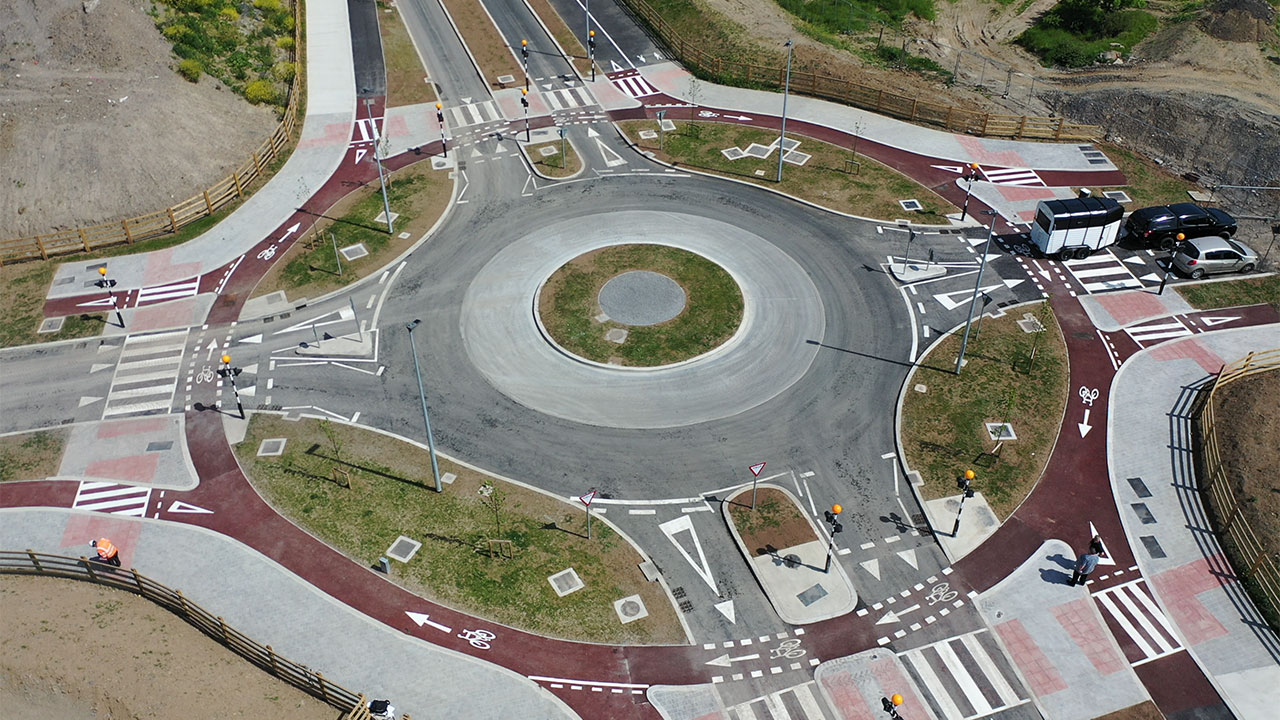
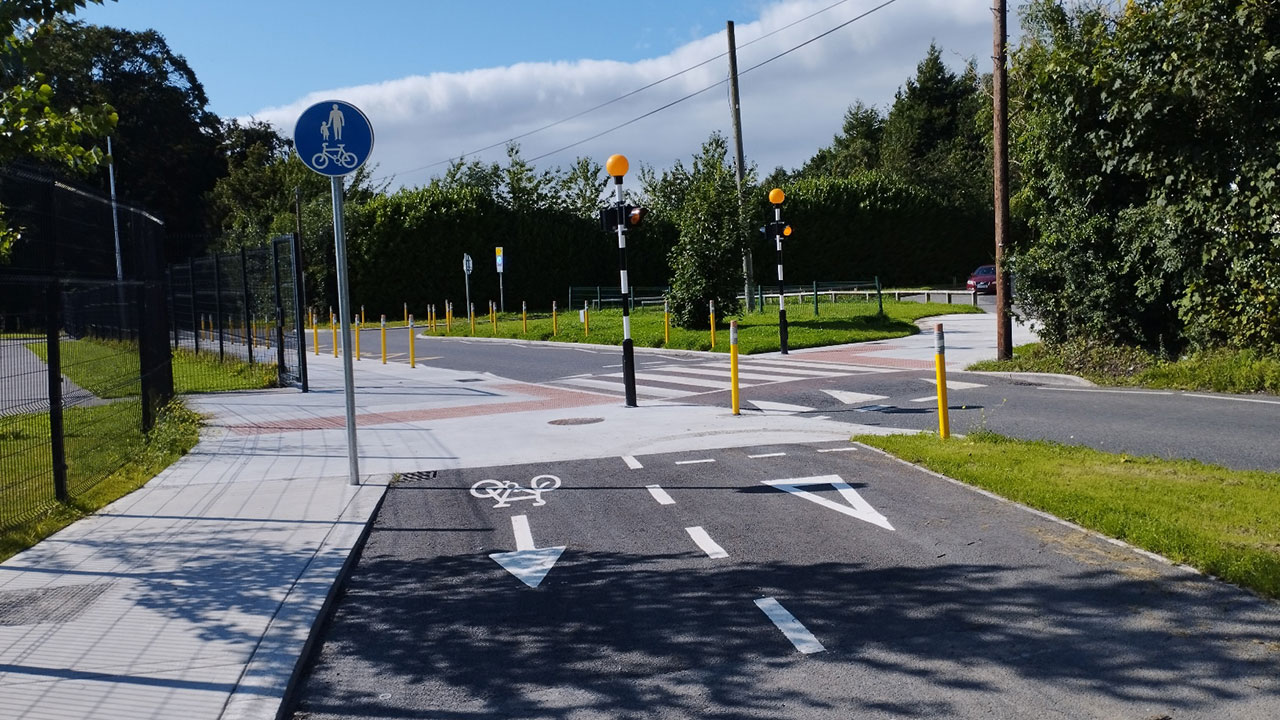
In a first for Ireland, we designed a new ‘Dutch-style’ cycle-friendly roundabout. This innovative layout separates cyclists, pedestrians and vehicles on the roundabout, with cyclists given priority and cars yielding to bicycles. This follows the hierarchy of road users’ concept, prioritising the most vulnerable and providing a safe environment for all users.
Challenge
The roundabout is designed to change driver behaviour, with narrowed lanes encouraging motorists to reduce their speed and move slowly through the junction. Drivers must give way to cyclists and pedestrians both when entering and exiting the roundabout.
These features are designed to increase safety for vulnerable road users by physically separating them from motor vehicles and increasing their visibility, but more importantly, separating pedestrians and cyclists through the junction and reducing the amount of conflicts between both users. Providing safe active travel facilities such as this in our cities and towns is vital if we are to decrease car dependency and encourage active travel.
There were a number of challenges to overcome due to the project’s innovative nature in Ireland. Examples include some concerns with the legality of the cycle-priority crossing of the carriageways on the roundabout, and the need to comply with an impending Cycle Design Manual.
These issues were overcome by the National Transport Authority (NTA) seeking legislative changes to ensure the legality of the cyclists being prioritised in crossing the carriageway, while in lieu of the new Cycle Design Manual, we developed the detailed elements of the roundabout using standards from the Netherlands and in collaboration with the NTA to ensure all requirements were met.
During the design of the Parkland Paths and Cycle Tracks elements, the footprint was in close proximity to some mature trees. An important consideration was to ensure there was little impact on tree roots by minimising excavations in these areas and incorporating root barriers under pathways.
Solution
As design consultants, working in conjunction with the NTA, we saw a unique opportunity to develop a new layout for the roundabout on this greenfield site. This new ‘Dutch-style’ cycle friendly roundabout design keeps pedestrians and cyclists fully segregated from one another and reduces conflict points. The junction also allows for more efficient travel of cyclists, who no longer must dismount to cross the carriageway with pedestrians.
With an increasing focus on active travel in Government, and an expansion of cycle lanes in recent years, this project is an important step in changing both the mindset of road users and enacting the legislation required to ensure active travel users are prioritised.
Following completion of the construction of the new cycle-friendly roundabout in May 2023, the roundabout has been used as a case study example in the NTA’s new National Cycle Design Manual 2023 (section 4.6.5.1 pg. 146).
As part of the publication of the new Cycle Design Manual, the NTA are also following through legislation change to ensure that cyclists have priority when crossing the carriageway which also directly affects the operation of this new roundabout.
As an infrastructure-led development, roads, high-quality cycle lanes and wide footpaths were built connecting various parts of the site to local schools, parks, churches and retail, ahead of the construction of new housing on the site. The result will be a coherently planned new residential area where facilities are in place before residential development.
At a glance
Client
Fingal County Council
Location
Dublin, Ireland
Services
Closeout and review, concept and feasibility, construction and implementation, design, enabling and procurement, options selection, statutory processes (Part 8 Planning)
The project featured in this article was undertaken by RPS, A Tetra Tech Company and originally published on RPSgroup.com. In March 2026 RPS rebranded to Tetra Tech.