

The Tetra Tech High Performance Buildings Group’s white paper, “Computational Fluid Dynamics (CFD) as a Strategic Enabler for AI-Driven Data Centers” examines the application of CFD as an operational and planning tool to understand airflow, heat transfer, and cooling system behavior in modern data centers.
The Challenge Facing Modern Data Centers
Artificial intelligence (AI) and high-performance computing workloads are fundamentally reshaping data center infrastructure. Rack densities are increasing rapidly, cooling architectures are becoming more complex, and sustainability targets are tightening under regulatory and stakeholder pressure.
At the same time, many facilities still rely on lagging operational indicators to manage risk, such as power usage effectiveness (PUE), water usage effectiveness (WUE), temperature alarms, and incident response. These metrics confirm outcomes after inefficiencies or failures have already occurred, often prompting conservative responses such as excessive cooling, lower supply temperatures, and increased water use. As margins shrink, this reactive approach becomes increasingly costly and unsustainable.
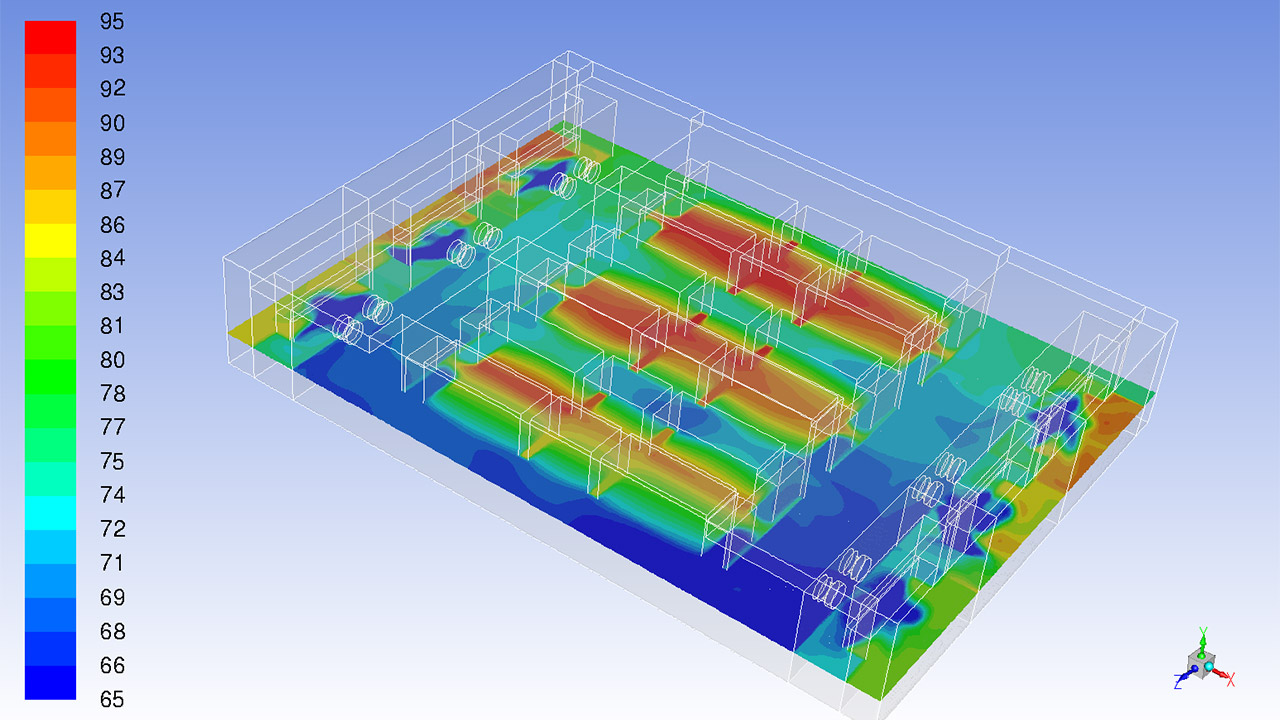
CFD helps operators address a simple question, “How do air, heat, and liquids move through real space under real operating conditions?” CFD quantifies and visualizes these behaviors using physics-based models rather than inference or suppositions, thus providing insight into situations that are difficult or impractical to measure directly.
By integrating CFD with commonly used performance metrics such as PUE and WUE, operators have been able to identify inefficiencies, evaluate failure and transition scenarios, and improve capacity utilization while managing operational risk.
Our latest white paper explores how CFD can help data center operators use predictive modelling. It presents a closed-loop operational framework, discusses practical CFD applications in air- and liquid-cooled environments, and summarizes representative performance outcomes from applied studies. It also outlines how CFD functions as a leading indicator for data center performance, why it is increasingly critical in hybrid air- and liquid-cooled environments, and how operators can use it to align AI growth plans with physical infrastructure realities.
Learn more about how to use CFD as a strategic enabler for AI-driven data centers.