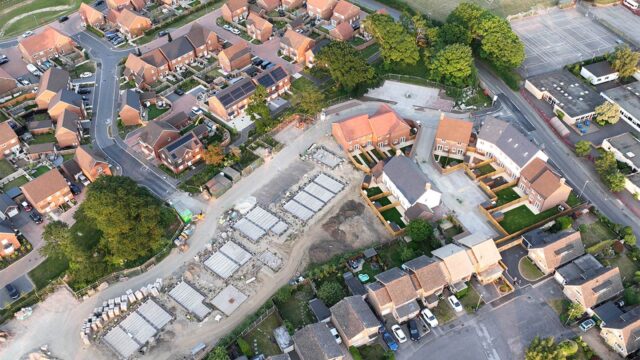

Jacob Bonehill, chartered town planner, explores the gap between planning policy and delivery and whether current UK planning reform is delivering more housing.
As planning reform continues to accelerate across the UK, the gap between policy and delivery is becoming harder to ignore. Tetra Tech’s recent panel discussion at UKREiiF, the UK’s leading real estate and infrastructure investment forum, assessed the impact of these reforms and whether they are helping us build more homes or simply reshaping the system around them.
The session brought together Bob Ghosh, award-winning architect and design review specialist; Robbie Calvert, head of policy and public affairs at the Royal Town Planning Institute; and Catherine Williams, planning director at the Home Builders Federation. Together the panel represented design, policy, and delivery at a national level.
The panel discussion focused on viability, capacity, and the growing disconnect between planning permissions and homes on the ground.
Is planning reform delivering more homes?
There is no question that the current reform agenda is ambitious. Policy is moving quickly and, in many respects, in the right direction. While interventions such as Grey Belt are already influencing behaviour and helping bring sites forward, the panel identified that changes in policy are not landing evenly across the country. Viability remains highly location-dependent, and in many areas—particularly outside of the strongest markets—it is already limiting delivery.
As Catherine Williams highlighted, “it’s very positive on the surface, but the reality of bringing sites forward is much more challenging.”
While reform is unlocking opportunity, it is not guaranteeing delivery. In fact, we are beginning to see uncertainty shaping behaviour, with developers moving quickly to promote sites not just because of opportunity, but because policy stability cannot be assumed in the longer term.
What is the biggest barrier to housing delivery?
The panel discussion, whether focused on planning, design, or delivery, consistently highlighted viability as a central constraint.
Catherine explained that while there is an increasing expectation that viability can be resolved earlier—particularly at the local plan stage—the reality is far more complex, stating, “you can’t determine viability with real certainty at the local plan stage.”
Too many variables still sit outside this process. Infrastructure requirements, abnormal costs, funding conditions, and market performance all shift over time. At the same time, the cumulative burden placed on development is continuing to grow.
This is where the challenge becomes more fundamental. It is not just about assessing viability, but about how much the system expects individual sites to absorb. Viability is now the defining constraint on UK housing delivery, but until that is addressed systemically, policy change alone will not unlock the volume of development required.
Planning versus capacity
Another issue identified by the panel was that capacity, rather than a lack of capability, was a key challenge within the system.
Robbie Calvert set this out clearly, highlighting that despite the emphasis on a plan-led system, “two-thirds of the country are still without an up-to-date plan.”
At the same time, new plan-making approaches, spatial development strategies, and local government change are all being introduced together. “There are a lot of moving parts and we’re heading into a very complex transition,” he concluded.
The result is a system under pressure. The UK planning system is not under-skilled; it is under-capacity. This extends beyond planners. It includes statutory consultees, inspectors, design professionals, and all the supporting services required to move development forward.
From a delivery perspective, this is critical. Without sufficient capacity across the whole system, even well-intentioned reform will struggle to translate into outcomes.
How is delivery changing?
Panel member Bob Ghosh brought a different and equally important perspective, focusing on how delivery risk is evolving. He outlined how the introduction of the Building Safety Act and wider regulatory changes are fundamentally altering how projects are brought forward. Decisions that were previously taken later in the process now need to be made much earlier, with developers carrying more risk from the outset. He stated, “the whole process has changed and we’re only just beginning that adjustment.”
This is already affecting how schemes are designed and delivered. In some cases, developers are actively adjusting proposals to reduce risk exposure, including limiting building heights and densities.
That has implications beyond viability. It affects placemaking, urban form, and the ability to deliver the kind of schemes the planning system is often seeking to encourage.
The widening gap between consent and construction
The strongest point of consensus across the panel was that there is a growing disconnect between planning approvals and delivery. We are generating more consents, but we are not building more homes. Catherine made the role of market conditions clear, saying, “if you want homes built, you need buyers.”
Sales rates are softening in many areas, build-out rates are slowing, and developers are responding accordingly. This highlights a critical point. Planning reform can unlock land, but it cannot, on its own, unlock delivery. Housing delivery is a system-wide issue, influenced by policy, infrastructure, viability, labour, and demand. Focusing on one in isolation will not resolve the challenge.
A shift towards integrated thinking
Despite the pressures, there are clear signs that the system is starting to evolve in the right direction. There is growing support for strategic planning and cross-boundary thinking. There is a stronger focus on consistency and predictability, particularly for SME developers. And there is recognition that structural change, including local government reform, can help create a more aligned and coordinated system.
Tetra Tech supports delivery in a changing system
What connects all of this is a move away from fragmented, site-by-site thinking. The system is beginning to think at scale. This is where an integrated approach becomes essential. Tetra Tech supports clients across the full development life cycle, from early-stage planning and site identification through to delivery and long-term asset performance. Our planning teams work alongside environmental, engineering, transport, and infrastructure specialists to help unlock sites, navigate complex regulatory environments, and bring forward deliverable schemes.
What differentiates this approach is the coordination of disciplines. Bringing planning, environmental, infrastructure, and engineering expertise together enables earlier identification of risk, better-informed decision-making and solutions that are more aligned with both policy and commercial reality.
In a system where viability, timing, and coordination are becoming defining factors, that joined-up capability is increasingly important.
Conclusion
The panel did not suggest that planning reform is failing. They highlighted genuine progress and clear intent, but they also identified that success cannot be measured by policy movement alone. It must be measured by delivery. Until permissions become homes, the job is only half done.
That means the next phase of this conversation must focus not just on reform, but on making the system work.
Key takeaways
- Planning reform is improving momentum, but not yet translating into the level of housing delivery required
- Viability is now the single most significant constraint on development
- The system’s biggest weakness is capacity, not capability
- The gap between planning consent and construction is widening
- More integrated approaches will be essential to convert reform into real-world outcomes
About the author

Jacob Bonehill
Jacob Bonehill is a passionate Chartered Town Planner at Tetra Tech, with 16 years’ experience working across major infrastructure projects in the private and public sector.
Jacob advises clients across both brownfield and greenfield sites on planning, environmental impact, and socio-economics within residential and industrial development.