

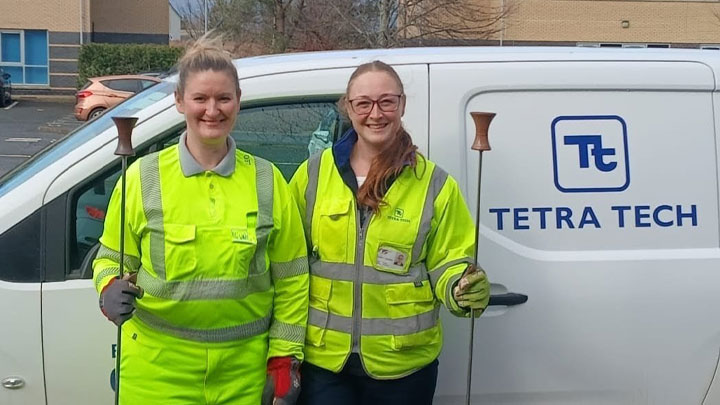
From building resilience to taking on a hands-on approach to the field, Caitlin understands the complexities and rewards of being a Leakage Technician. With her father having worked for Tetra Tech, Caitlin revels in how varied and engaging her role at Tetra Tech can be.
In this interview, she shares what skills you need to succeed as a Leakage Technician and what advice she would give to the next generation of teams.

What drew you to work on Tetra Tech’s water team?
It was my dad who got me into it. He worked with Tetra Tech for years. I was only self-employed at the time, so I was looking for something long-term that was more secure in terms of my pension and health benefits. My dad knows I like a job where I’m outside and doing things. I’m not one for sitting in an office. I ended up joining, and since then, it’s been great. There’s so much to the role, and the company keeps you engaged and continually learning.
What skills and qualities do you need to be successful in your role?
Being good with the public. You need to have a good air of professionalism when dealing with people. Also, you need to be robust because we work in all weather conditions, from snow and ice to heavy winds. So, you need to be quite turgid when it comes to that and enjoy what comes.
What advice would you give to someone looking to pursue a career in water resource management?
If somebody’s very new to the role, like I was, I’d recommend that they do their research. I was fortunate enough to know people within the water field, to speak to them, to know what the interview process was like, and to learn about your DMAs (District Metering Areas) and the equipment they use. It’s a very good job to do. If you do your research into the company and into what the job role involves, and it sounds like it would be good for you, then yeah, absolutely go for it. I think that’s what made me go to the role: an interest in the work itself. The more there is to learn, and the more complicated it is for me, the more interested I am in doing it.
How does your work contribute to building sustainable communities?
A lot of the leaks that we’re finding have been here for years and years, so they’ve started deteriorating the roads underneath. When we find leaks like things like that, it means the council can then come in and repair the road. Another example is farmland. If farmers’ land is flooded into marshes instead of fields, it means that they can’t use it for their cattle, or they can’t grow crops. So, it may just be the water system that we’re there to fix, but it does have that knock-on effect of doing good and triggering bigger repairs that are needed. It means we can help a huge variety of people and environments, whether that’s farmland, roads or people’s homes.
Join our team. We are hiring for a variety of positions on our water team in the UK and Europe.