Victoria Brayshaw, head of civil engineering in Tetra Tech’s UK division, explores how water quality and flood risk are two of the most significant constraints on UK water infrastructure development and why integrated, catchment-scale planning is essential to unlock resilient and sustainable growth.
Development in the UK is operating under increasing pressure. Climate risk, regulatory scrutiny, and rising expectations of environmental performance are changing how sites are brought forward. The question is no longer whether we can balance growth with water quality and flood resilience, but whether we are organised to deliver both in a coordinated way.
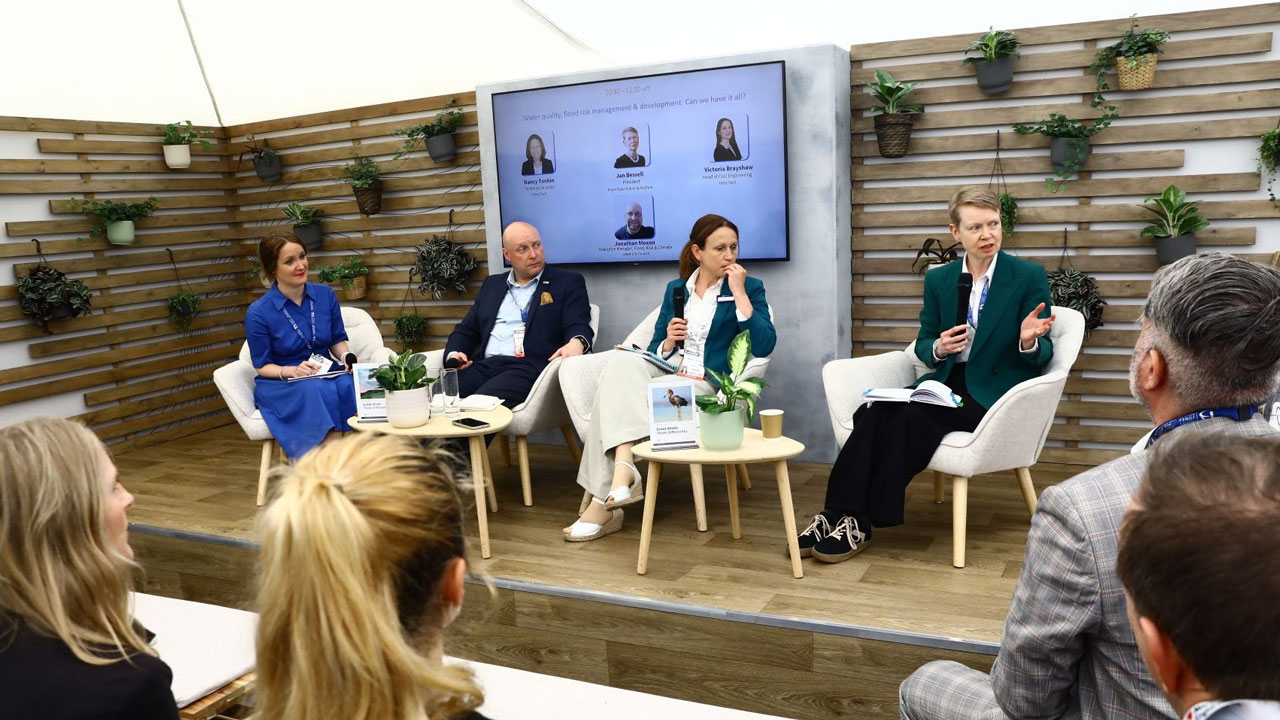
At UKREiiF, the UK’s leading real estate and infrastructure investment forum, Tetra Tech hosted a panel to explore this challenge. The panel brought together perspectives from planning, local authority delivery, and environmental risk, with representatives from Leeds City Council, The Royal Town Planning Institute (RTPI), and Tetra Tech’s own experts.
The Challenge: Growth, Climate Pressure, and Increasing Constraints
The session opened by looking at what good development should achieve: Can the industry deliver development and infrastructure at pace while also improving water quality, reducing flood risk, and creating places that are fit for the future? The consensus from the panel was that the challenge is not whether growth and better water outcomes can coexist, but whether we are organised to deliver them in a joined-up way.
Development is an opportunity
Development is still too often framed around pressure, burden, and impact rather than the opportunity to improve systems and outcomes. Panel member Jonathan Moxon, executive manager of flood risk and climate resilience at Leeds City Council challenged that perception stating, “it is the best tool we’ve got in the city” when talking about development and flood risk and further described it as “our biggest tool” for reducing flood risk when it is done properly.
Development is one of the few mechanisms that consistently brings investment, technical input, and the chance to reshape how land functions. When well planned, it can improve drainage, rethink flood pathways, create blue-green infrastructure, and build in resilience to avoid costly retrofitting. The challenge is that the current process considers sites in isolation, rather than connecting each scheme into a wider strategic outcome.
Why site-by-site thinking is starting to fail
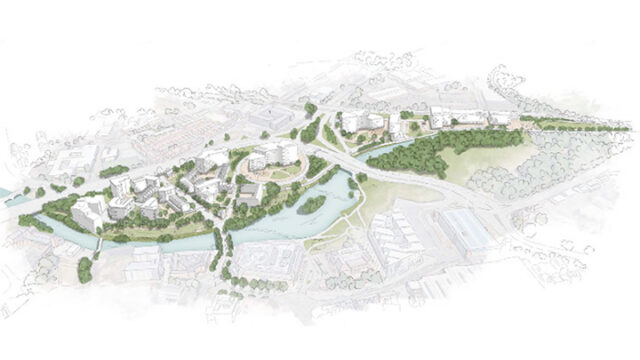
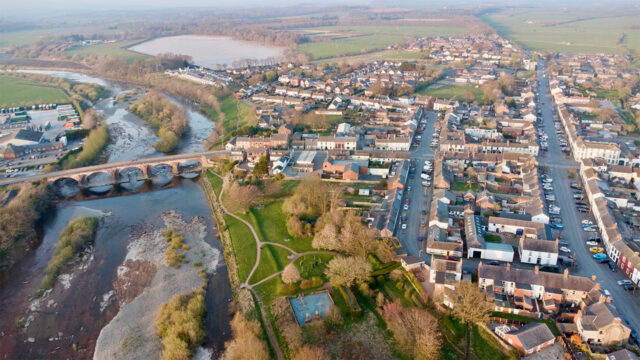
The panel highlighted the limitations of fragmented delivery, with local authorities handling large volumes of planning applications, all of which look to solve each scheme’s individual challenges. What is clear is that water does not behave according to ownership boundaries, red lines, or committee timetables. It moves through systems, and the more complex those systems become, the less sense it makes to treat risk as a collection of disconnected local problems.
Jan Bessel, president of RTPI, commented that planning in the UK does not lack the tools to address the issue. The UK’s risk-based planning framework already includes climate resilience and sustainable drainage, but too often we continue to apply these tools in silos. “Planning is the enabler, not the blocker,” she said.
The real gap is between the existence of a framework and our collective ability to use it in a way that is spatially strategic, integrated across disciplines, and grounded in place. That is why catchment thinking matters. If the upstream land use, urban drainage network, receiving water environment, and development pipeline are all affecting each other, then the only sensible approach is to plan them together.
The discussion also explored how local flood risk outcomes are directly shaped by decisions far beyond the site frontage. The same is true from a water quality perspective, with panel member Nancy Tonkin, technical director at Tetra Tech, noting that catchment-scale management is “so imminently sensible” when compared with repeatedly reacting to one small site after another.
Water runs through systems, not sites. If we continue trying to solve flood risk and water quality one application at a time, we will keep repeating the same problems instead of unlocking better places.
Victoria Brayshaw, head of civil engineering in Tetra Tech’s UK division
Water quality is now a development issue
Flood risk may be more visible, but water quality is becoming just as significant a constraint on growth. Nancy made that point powerfully through the lens of contamination. Traditional contaminants are better understood and, in many cases, better regulated. The more difficult challenge now lies in what she described as “contaminants that nobody knew were there,” including PFAS, antimicrobial resistance, and microplastics. These are not marginal technical issues; they are becoming central to site viability, regulatory challenge, cost, and long-term environmental performance.
What makes this especially difficult is the gap between scientific concern and regulatory clarity. Nancy noted that the technology and the legislation are both behind where they need to be, and that the sector lacks clear guidance on the levels regulators will expect. That uncertainty creates friction in transactions, planning, and remediation strategy. It also means water quality can no longer be treated as a late-stage technical workstream. If due diligence is superficial, contamination is waved away, or groundwater linkages are poorly understood, those issues will return later in more expensive and more disruptive forms.
Nature-based solutions are no longer optional
Another theme that surfaced during the session was the role of nature-based solutions, which sit at the intersection of flood resilience, water quality, placemaking, and climate adaptation. Jan described the use of an ecosystems approach as “absolutely essential,” while Jonathan gave what was perhaps the most memorable line of the session, saying that “we need to stop pretending that we’re better than Mother Nature.”
That is not a case against engineering; it is a case for broadening our understanding of performance. A swale, wetland, street tree, or restored watercourse can deliver storage, interception, cooling, biodiversity, health, and amenity at the same time. Hard infrastructure still has its place, but we should not be defaulting to single-purpose interventions where integrated alternatives can do more. Tetra Tech’s flood and catchment work reflects the same principle, combining engineering, modelling, and nature-based design to support sustainable drainage, integrated urban water planning, and natural flood management.
Viability, delivery, and the burden on individual sites
The viability challenge also sat beneath much of the discussion. Many complex sites come forward simply because that’s what’s left. That is true for redevelopment land, constrained urban locations, and many of the places where water companies are trying to deliver storage or treatment interventions.
Jonathan’s observations on infrastructure funding added an important practical layer to that discussion. He brought in the role of the Community Infrastructure Levy and the need to use investment more proactively to enable future development, rather than only reacting to existing deficits. That shift in mindset is crucial. If we continue expecting every scheme to carry the full weight of long-standing systemic problems, we will keep slowing down projects that could otherwise help deliver a more resilient future.
We need to stop pretending that we’re better than Mother Nature.
Jonathan Moxon, executive manager of flood risk and climate resilience at Leeds City Council
How Tetra Tech helps clients respond
The challenge set out in the session is not simply one of flood modelling, contamination advice, planning policy, or engineering design in isolation. It is about bringing those disciplines together early enough to shape better decisions. Tetra Tech’s water and infrastructure teams support clients through flood risk management, integrated catchment planning, groundwater and water quality assessment, regulatory support, and catchment-scale water resource strategy. That integrated capability is increasingly important where projects need to move from compliance thinking to coordinated delivery.
In practical terms, that means supporting clients at the points where development risk is often created or locked in: site selection, due diligence, catchment context, drainage and flood strategy, contamination pathways, regulatory engagement, and stakeholder alignment. It also means drawing on digital tools and data-led modelling to test options early and avoid solving the wrong problem in the wrong place. This builds on the thinking we have explored previously, bringing integrated planning, digital tools, strategic storage, and catchment-scale approaches together to support more resilient outcomes.
In conclusion, success is no longer just about getting development consent or meeting minimum technical thresholds. Success is creating places that can absorb change, support growth, and improve the systems they sit within. That means being more ambitious about integration, more honest about the limits of fragmented delivery, and more deliberate about where and how we invest. The opportunity is significant, but so is the risk of repeating the past. As Jan warned, failure would mean “building faster but creating the next generation of uninsurable flood and pollution problems.” We cannot afford that outcome. We have to use this moment to do better.
About the author
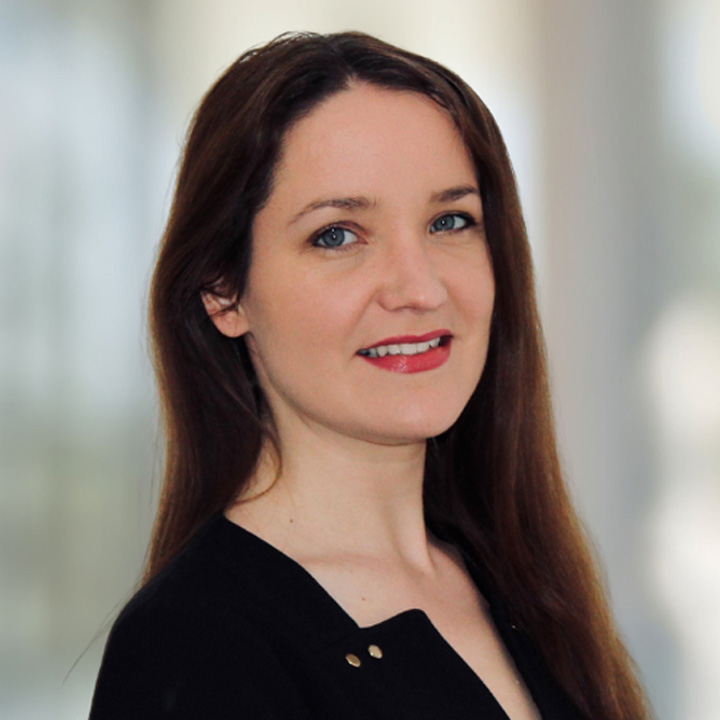
Victoria Brayshaw
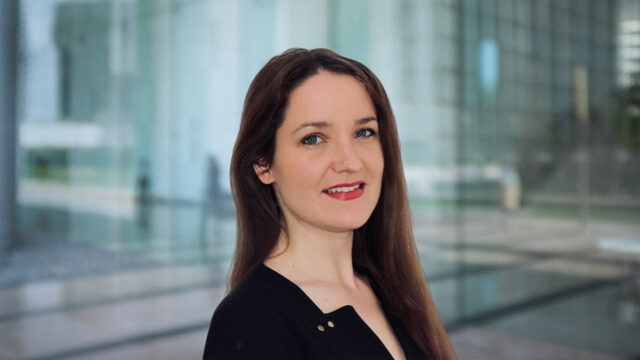
Victoria Brayshaw is the head of civil engineering and technical development lead in Tetra Tech’s UK division.
She is a fellow of the Institution of Civil Engineers (ICE) and leads a national team of more than 100 engineers, designers, and flood risk management consultants. She has been involved with ICE for more than 20 years, including as a supervising civil engineer, a branch chair, and regional committee member.