
Jonathan Davis, director of business development, explores why confidence has become one of the most valuable assets in data centre development and what organisations must do to turn opportunity into investable, deliverable projects.
While demand for digital infrastructure remains strong, investors are becoming more selective by placing greater emphasis on certainty of delivery, planning clarity, power availability, and effective risk management. As global competition intensifies, the UK’s ability to attract investment will increasingly depend on how successfully these interconnected challenges are addressed.
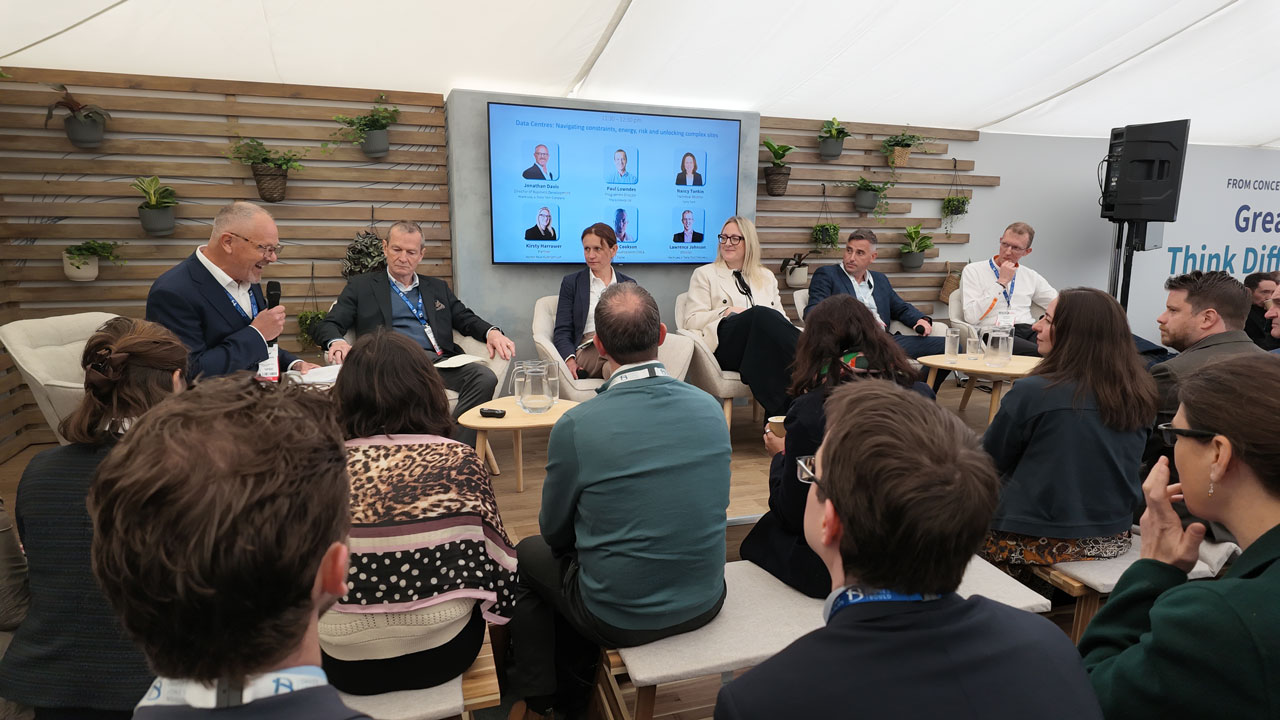
Tetra Tech’s panel discussion at UKREiiF, the UK’s leading real estate and infrastructure investment forum, brought together industry leaders to explore how certainty, collaboration, and early risk management are shaping data centre investment decisions.
Unlocking investment in data centres is not about solving a single constraint. It is about bringing together a series of interdependent challenges at exactly the right moment.
There are five key elements: a technical and commercial solution, people and stakeholders on board, legal compliance, and a need to address some specific local conditions.
To explore these elements more fully, we brought together a panel that reflected the reality of delivery. Panel members were Tetra Tech’s Nancy Tonkin, technical director, and Laurence Johnson, director of energy economics; Paul Lowndes, programme director at This is Gravity; Kirsty Harrower, partner at Norton Rose Fulbright; and Adam Cookson, director of development for Europe, Middle East, and Africa at Edged.
What emerged was not a list of isolated challenges, but a clearer view of how the market is evolving and what it now takes to deliver successfully.
Why invest in the UK?
While the UK remains a core market supported by strong connectivity, infrastructure, and continued hyperscale demand, it is no longer a market that wins investment by default. From an international perspective, Adam Cookson made clear that projects are now assessed side-by-side across multiple countries, with certainty of delivery carrying as much weight as return. That shift means the UK is no longer competing on opportunity alone; it is competing on confidence.
Power is no longer the only critical factor
Power dominated much of the discussion. Laurence Johnson outlined the growing imbalance between grid capacity and demand, with applications far exceeding what can realistically be delivered. The system is already filtering projects, and not every scheme in the pipeline will progress.
However, the conversation quickly moved beyond power in isolation. There is a tendency to view access to energy as the defining factor in site viability, but the panel challenged that thinking. In the UK market, network proximity and occupier demand remain critical. Sites that are well powered but poorly located struggle to convert into deliverable opportunities.
Adam’s perspective was clear. Without alignment between power, land, connectivity, and customer demand, projects will stall. The market is becoming more disciplined, with greater scrutiny applied earlier in the life cycle. At the same time, inefficiencies in the system are becoming more visible, particularly where power has been secured well beyond what can realistically be used.
Planning continues to define outcomes
If power shapes the conversation, planning continues to define outcomes. From an international developer’s perspective, the UK’s planning system remains complex and, at times, uncertain. When compared with more structured approaches elsewhere in Europe, this lack of clarity can shift projects into a higher-risk category.
That uncertainty carries direct commercial implications. As Kirsty Harrower noted, the sector is driven by speed to market. Delays or ambiguity in planning reduce viability and affect how projects are prioritised against competing opportunities. For investors operating globally, certainty is often the difference between progressing or stepping away.
Encouragingly, there was recognition that this can be addressed. More structured approaches, including zoning and defined planning frameworks, are beginning to demonstrate value. Where parameters are clear from the outset, risk is reduced and delivery becomes more predictable. This shift toward certainty reflects how the market is adapting to global competition.
Land, and particularly brownfield development, was another important theme. In many markets, this would be seen as a constraint; but in the UK, it is an established strength.
Nancy Tonkin highlighted that the technical challenges of developing brownfield sites are well understood. The regulatory framework is robust, risks can be assessed early, and mitigation strategies are proven. When sites are properly understood, risk becomes manageable and can be treated as a cost within the overall viability of a project.
The issue is often not the complexity itself, but how it is communicated. Where projects lack clear, structured information—particularly when assessed by international investors—manageable challenges can quickly be perceived as barriers. Adam reinforced this point, noting that credibility matters. Projects supported by strong advisory teams, clear due diligence, and defined delivery strategies are far more likely to progress, even where challenges exist.
Despite the range of constraints discussed, the panel was clear that development is still happening. Projects are moving forward, but with greater discipline and a sharper focus on risk.
Permitting and power are key to unlocking investment
From a funding perspective, Adam highlighted that permitting and power are now the two areas of greatest scrutiny. These risks must be clearly defined and managed to unlock investment. This is shaping how deals are structured, with greater use of conditionality, phased commitments, and clearer allocation of responsibilities.
Kirsty added that legal structuring is central to enabling this. Where risks are clearly understood and appropriately shared, projects can progress with confidence. Where uncertainty remains, even strong opportunities can stall. It is not risk that prevents development; it is a lack of clarity.
Alongside the technical and commercial considerations, the importance of community alignment also came through strongly. Paul Lowndes shared his experience from This is Gravity, where long-term engagement with local stakeholders has been fundamental to delivery. Developments must operate as good neighbours, aligning with the communities they sit within and delivering wider benefits beyond the asset itself.
As the discussion drew to a close, timing became a central theme. The pace of change across the sector is accelerating and global competition is intensifying. Other markets are moving quickly to simplify processes and attract investment.
There is a clear sense that the UK has a window of opportunity, but it is not indefinite. The fundamentals remain strong, but success will depend on how effectively barriers to delivery are addressed.
There are five different keys to unlocking investment. You need a technical solution, a commercial solution, people and stakeholders need to be on board, the project needs to be legally compliant, and you need to address some specific local conditions.
Interdependencies are growing
Reflecting on the session, what stands out is the level of interdependency across every aspect of development. Power, planning, land, environmental risk, and stakeholder considerations can no longer be treated in isolation. They must be brought together early, with a clear and deliverable strategy.
That is where Tetra Tech is well placed to support clients. Across the panel itself, that integrated capability was evident, spanning energy strategy, infrastructure, environmental risk, and remediation.
In practical terms, this means helping clients move from identifying opportunities to structuring them in a way that is clear, credible, and investable. It means aligning energy strategies with demand, establishing planning pathways that reduce uncertainty, and translating complex site conditions into viable development propositions.
It also means supporting the commercial realities of delivery. As the panel highlighted, projects progress where risks are clearly understood and proactively managed. Bringing technical, environmental, and commercial thinking together early allows those risks to be addressed before they become barriers.
Ultimately, it comes down to confidence. Confidence in the strategy, the data, and the pathway to delivery. Because the opportunity in the UK remains significant, the challenge is not identifying it but navigating it successfully.
About the author

Jonathan Davis
Jonathan Davis is director of business development with more than 20 years’ experience working in built environment consultancy.
He supports clients to develop, build, and deliver projects in the energy and industrial sectors, including utility scale power generation and storage. Jonathan also helps clients create robust asset development pathways, reduce risk, and build a compelling case for investment.