PFAS Analysis
Tetra Tech provides UKAS-accredited PFAS analysis to help clients detect, assess, and manage per- and polyfluoroalkyl substances in complex environmental and industrial matrices.
Tetra Tech offers industry-leading PFAS (per- and polyfluoroalkyl substances) analysis from our UKAS-accredited environmental testing laboratories. Our laboratories operate under ISO/IEC 17025 standards, ensuring the highest levels of quality and reliability. We are recognised as a Centre of Excellence for PFAS analysis and deliver market-leading solutions with a proven track record of supporting some of the UK’s most complex investigations. As awareness of PFAS-related risks grows, we support clients across environmental, construction, manufacturing, and defence sectors in meeting their regulatory, legal, and operational obligations.
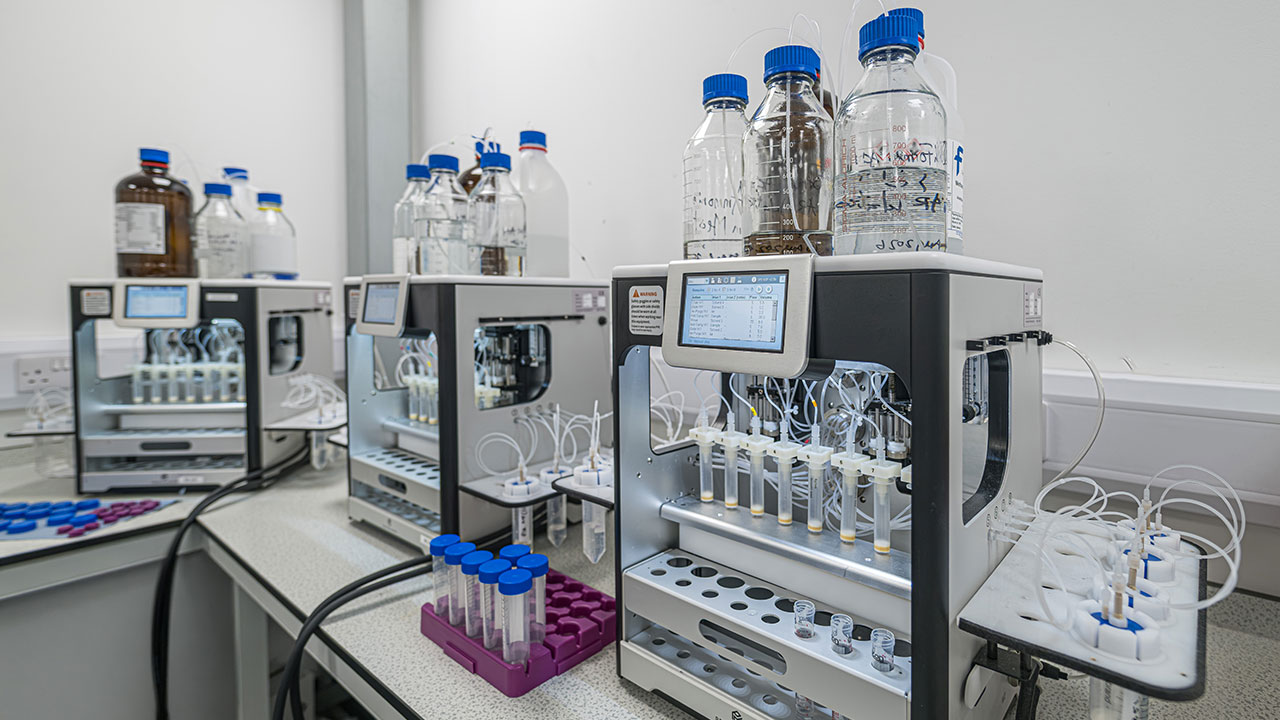
We use advanced testing methodologies, including liquid chromatography tandem mass spectrometry (LC-MS/MS), to detect trace levels of PFAS in soil, water, biosolids, sediments, food and other complex matrices. Our laboratories are staffed by highly qualified scientists with extensive experience in PFAS detection, method development, and regulatory compliance. We work closely with clients to deliver fast, reliable results, empowering them to make informed decisions and comply with national and international standards.
Comprehensive PFAS Testing Suite
Our PFAS testing covers a wide spectrum of substances across environmental and industrial samples, with UKAS‑accredited analysis for wastewater, surface water, groundwater, drinking water (non‑regulatory), biosolids, sediments and other complex matrices. We offer a targeted PFAS‑58 suite (extendable to 60 with 8:2 and 10:2 diPAP), methods that map to regulatory lists including the EU DWD PFAS20 and the DWI PFAS48, and routine sub‑nanogram‑per‑litre detection limits aligned with WFD and EQS requirements. We analyse fluorotelomer alcohols (6:2, 8:2, 10:2 FTOHs) and a range of short‑chain PFAS including trifluoroacetic acid (TFA), and provide Total Organic Fluorine (TOF) by Combustion Ion Chromatography and Total Oxidisable Precursor (TOP) assays to support risk assessment and due diligence. Our laboratory supports water companies, remediation projects, pilot treatment trials, and government and academic research, and we actively participate in external proficiency testing schemes and steering groups to ensure data quality.
PFAS 60 Testing Suite
Our testing suite includes the DWI PFAS 48 and EU DWD PFAS 20.
The UK drinking water inspectorate as of 31 December 2021 requires that all drinking water is monitored for a list of 48 PFAS compounds to gather further information on their levels and prevalence in UK supplies. We have developed a targeted method to detect 54 PFAS compounds in one run, and can add an additional 2 accredited fluorotelomer phosphate diesters 8:2 and 10:2 diPAP on request, to assist water companies and private supplies to meet this new regulatory requirement and have been granted UKAS accreditation for 48 of these PFAS at sub-nanogram levels in ground water, surface water, drinking water (non-regulatory), untreated sewage, and treated sewage effluent.
| PFAS ID | Abbreviation | Chemical Name | CAS Number |
|---|---|---|---|
| 1 | 10:2 FTSA | 1H,1H,2H,2H-perfluorododecane sulfonic acid (10:2 FTSA) | 120226-60-0 |
| 2 | 3:3 FTCA | 3-perfluoropropyl propanoic acid (3:3 FTCA) | 356-02-5 |
| 3 | 4:2 FTSA / 4:2 FTS | 1H,1H,2H,2H-perfluorohexane sulfonic acid (4:2 FTSA) | 757124-72-4 |
| 4 | 5:3 FTCA | 3-perfluoropentyl propanoic acid (5:3 FTCA) | 914637-49-3 |
| 5 | 6:2 diPAP | bis(1H,1H,2H,2H-perfluorooctyl) phosphate (6:2 diPAP) | 57677-95-9 |
| 6 | 6:2 FTAB | carboxyMeDiMe-3-[[(tridecaFlOct)sulfi]amino]prop amm hydrox (6:2 FTAB) | 34455-29-3 |
| 7 | 6:2 FTSA / 6:2 FTS | 1H,1H,2H,2H-perfluorooctane sulfonic acid (6:2 FTSA) | 27619-97-2 |
| 8 | 7:3 FTCA | 3-perfluoroheptyl propanoic acid (7:3 FTCA) | 812-70-4 |
| 9 | 8:2 FTSA / 8:2 FTS | 1H,1H,2H,2H-perfluorodecane sulfonic acid (8:2 FTSA) | 39108-34-4 |
| 10 | DONA | dodecafluoro-3H-4,8-dioxanonanoic acid (DONA) | 919005-14-4 |
| 11 | EtFOSE | 2-(N-ethylperfluoro-1-octanesulfonamido)-ethanol (EtFOSE) | 1691-99-2 |
| 12 | F-53B Major / Cl-PFESA | 9-chlorohexadecafluoro-3-oxanonane-1-sulfonic acid (F-53B Major) | 756426-58-1 |
| 13 | F-53B Minor / Cl-PFESA | 11-chloroeicosafuoro-3-oxaundecane-1-sulfonic acid (F-53B Minor) | 763051-92-9 |
| 14 | FBSA | perfluoro-1-butanesulfonamide (FBSA) | 30334-69-1 |
| 15 | FHxSA | perfluoro-1-hexanesulfonamide (FHxSA) | 41997-13-1 |
| 16 | FOSA / PFOSA | perfluoro-1-octanesulfonamide (PFOSA) | 754-91-6 |
| 17 | HFPO-DA / Gen X | 2,3,3,3-tetrafluoro-2-(heptafluoropropoxy)propanoic acid (HFPO-DA/GenX) | 13252-13-6 |
| 18 | HFPO-TA | perfluoro-2,5-dimethyl-3,6-dioxanonanoic acid (HFPO-TA) | 13252-14-7 |
| 19 | MeFOSE | 2-(N-methylperfluoro-1-octanesulfonamido)-ethanol (MeFOSE) | 24448-09-7 |
| 20 | N-AP-FHxSA | N-(3-dimethylaminopropan-1-yl)perfluoro-1-hexanesulfonamide (N-AP-FHxSA) | 50598-28-2 |
| 21 | N-EtFOSA | N-ethylperfluoro-1-octanesulfonamide (N-EtFOSA) | 4151-50-2 |
| 22 | N-EtFOSAA | N-ethylperfluoro-1-octanesulfonamidoacetic acid (N-EtFOSAA) | 2991-50-6 |
| 23 | NFDHA | perfluoro-3,6-dioxaheptanoic acid (NFDHA) | 151772-58-6 |
| 24 | N-MeFOSA | N-methylperfluoro-1-octanesulfonamide (N-MeFOSA) | 31506-32-8 |
| 25 | N-MeFOSAA | N-methylperfluoro-1-octanesulfonamidoacetic acid (N-MeFOSAA) | 2355-31-9 |
| 26 | PFBA | perfluoro-n-butanoic acid (PFBA) | 375-22-4 |
| 27 | PFBS | perfluoro-1-butanesulfonic acid (PFBS) | 375-73-5 |
| 28 | PFDA | perfluoro-n-decanoic acid (PFDA) | 335-76-2 |
| 29 | PFDoDA | perfluoro-n-dodecanoic acid (PFDoDA) | 307-55-1 |
| 30 | PFDoDS | perfluoro-1-dodecanesulfonic acid (PFDoDS) | 79780-39-5 |
| 31 | PFDS | perfluoro-1-decanesulfonic acid (PFDS) | 335-77-3 |
| 32 | PFECHS | perfluoro-4-ethylcyclohexanesulfonic acid (PFECHS) | 646-83-3 |
| 33 | PFEESA | perfluoro-(2-ethoxyethane)-sulfonic acid (PFEESA) | 113507-82-7 |
| 34 | PFHpA | perfluoro-n-heptanoic acid (PFHpA) | 375-85-9 |
| 35 | PFHpS | perfluoro-1-heptanesulfonic acid (PFHpS) | 375-92-8 |
| 36 | PFHxA | perfluoro-n-hexanoic acid (PFHxA) | 307-24-4 |
| 37 | PFHxDA | perfluoro-n-hexadecanoic acid (PFHxDA) | 67905-19-5 |
| 38 | br-PFHxS | perfluoro-1-hexanesulfonic acid (br-PFHxS) | |
| 39 | L-PFHxS | perfluoro-1-hexanesulfonic acid (L-PFHxS) | 355-46-4 |
| 40 | sum-PFHxS | perfluoro-1-hexanesulfonic acid (PFHxS Sum L and br) | |
| 41 | PFMOBA | perfluoro-5-oxahexanoic acid (PFMOBA) | 863090-89-5 |
| 42 | PFMOPA | perfluoro-4-oxapentanoic acid (PFMOPA) | 377-73-1 |
| 43 | br-PFNA | perfluoro-n-nonanoic acid (br-PFNA) | |
| 44 | L-PFNA | perfluoro-n-nonanoic acid (L-PFNA) | 375-95-1 |
| 45 | Sum-PFNA | perfluoro-n-nonanoic acid (PFNA Sum L and br) | |
| 46 | PFNS | perfluoro-1-nonanesulfonic acid (PFNS) | 68259-12-1 |
| 47 | br-PFOA | perfluoro-n-octanoic acid (br-PFOA) | |
| 48 | L-PFOA | perfluoro-n-octanoic acid (L-PFOA) | 335-67-1 |
| 49 | sum-PFOA | perfluoro-n-octanoic acid (PFOA Sum L and br) | |
| 50 | PFOcDA | perfluoro-n-octadecanoic acid (PFOcDA) | 16517-11-6 |
| 51 | br-PFOS | perfluoro-1-octanesulfonic acid (br-PFOS) | |
| 52 | L-PFOS | perfluoro-1-octanesulfonic acid (L-PFOS) | 1763-23-1 |
| 53 | sum-PFOS | perfluoro-1-octanesulfonic acid (PFOS Sum L and br) | |
| 54 | PFPeA | perfluoro-n-pentanoic acid (PFPeA) | 2706-90-3 |
| 55 | PFPeS | perfluoro-1-pentanesulfonic acid (PFPeS) | 2706-91-4 |
| 56 | PFTeDA | perfluoro-n-tetradecanoic acid (PFTeDA) | 376-06-7 |
| 57 | PFTrDA | perfluoro-n-tridecanoic acid (PFTrDA) | 72629-94-8 |
| 58 | PFTrDS | perfluoro-1-tridecanesulfonic acid (PFTrDS) | 791563-89-8 |
| 59 | PFUnDA | perfluoro-n-undecanoic acid (PFUnDA) | 2058-94-8 |
| 60 | PFUnDS | perfluoro-1-undecanesulfonic acid (PFUnDS) | 749786-16-1 |
Ultrashort-Chain PFAS Suite C1 – C3
Ultrashort-chain PFAS are increasingly important to monitor because they are highly mobile in the environment, readily dissolve in water, and can pass through many conventional treatment processes. As longer-chain fluorinated compounds break down they ultimately form shorter-chain alternatives, and concentrations of ultrashort-chain compounds are becoming more prevalent in groundwater, drinking water, and wastewater. Monitoring these substances is essential to understanding their environmental fate, assessing potential human and ecological exposure, and ensuring that regulatory frameworks keep pace with emerging PFAS contamination risks.
We have developed a suite of 10 ultrashort-chain PFAS with carbon chain length between C1 – C3 to allow us to monitor their prevalence alongside the ongoing monitoring we are carrying f for TFA as part of the UK National Chemical Investigations Programme (CIP).
Target Analytes
| Compound Name | Abbreviation | Carbon Length |
|---|---|---|
| 2,2,3,3-Tetrafluoropropanoic acid | 2,2,3,3-TFPA | C3 |
| 2,3,3,3-Tetrafluoropropanoic acid | 2,3,3,3-TFPA | C3 |
| Perfluoropropanoic acid | PFPrA | C3 |
| 1,1,1-Trifluoro-N-[(trifluoromethyl)sulfonyl]methanesulfonamide | TfSi | C2 |
| Trifluoroacetic acid | TFA | C2 |
| Trifluoromethanesulfonic acid | TFMS | C1 |
| Perfluoropropane-sulfonic acid | PFPrS | C3 |
| Perfluoroethanesulfonic acid | PFEtS | C2 |
| Difluoroacetic acid | DFA | C2 |
| Perfluoro-2-methoxyacetic acid | PFMOAA | C3 |
Accreditation