
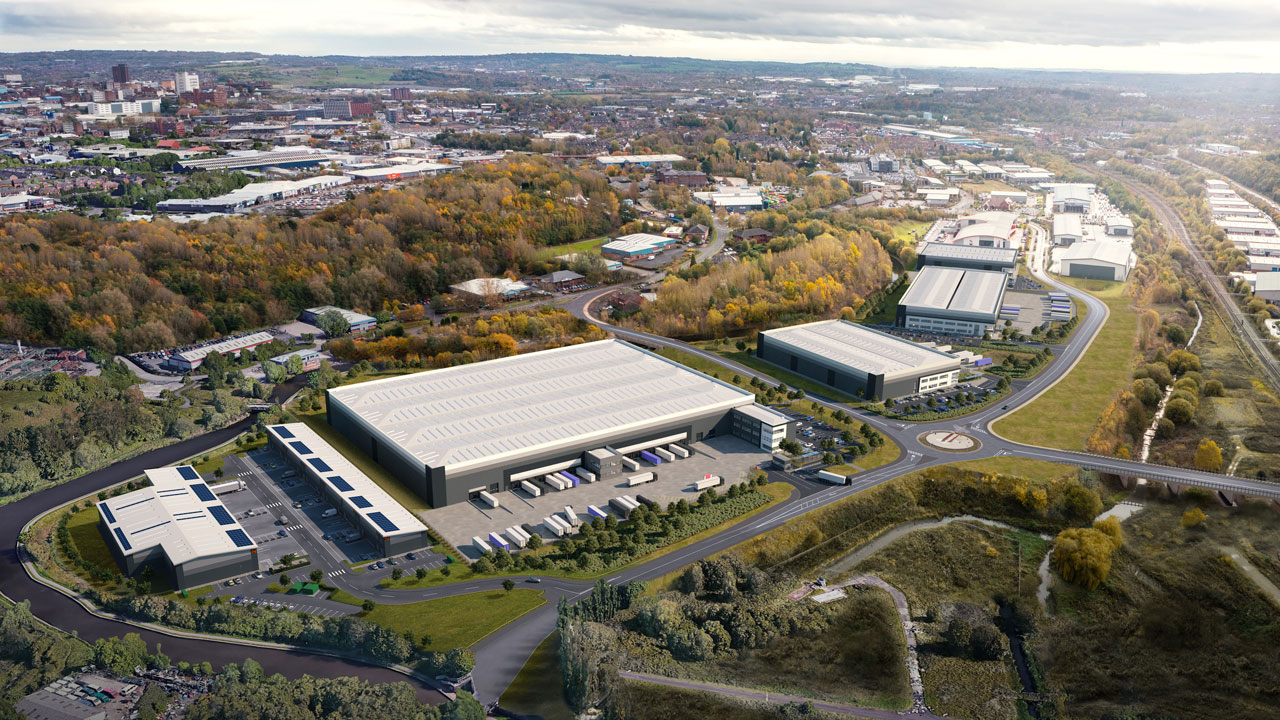
Our experts Keith Fulton, Angela Schembri, Kester Purslow, and Tilo Hoelzel explore how the industrial sector is evolving and what’s needed to enable project delivery at pace.
Across data centres, advanced manufacturing, logistics and distribution, similar pressures and enablers are shaping the market: power, planning, design, energy, and digital infrastructure.
Demand in the UK and Europe remains strong, but investment and development decisions are becoming more selective, with growth dependent on the right combination of strategic land, infrastructure, and delivery certainty.
Over the course of 2026, our experts attended a variety of conferences and industry events, including ShedMasters, UKREiiF, and Datacloud Global Congress. In this article, they share key learnings and takeaways to help clients identify and progress industrial opportunities in 2027 and beyond.
1. Policy is shaping infrastructure-led industrial development
The UK’s Modern Industrial Strategy 2025 is shaping industrial development growth across priority sectors, including digital and technology, advanced manufacturing, and clean energy, by increasing business investment and supporting the infrastructure, skills, and supply chains needed for long-term growth.
Recent changes to England’s National Planning Policy Framework, published in August 2026, support more coordinated consenting for data centre developments. They require Local Planning Authorities to plan more effectively for data centres, taking account of the location of Industrial Strategy Zones and AI Growth Zones. They also give greater weight to proposals that support economic growth and the Government’s Industrial Strategy. The NPPF recognises that data centres, which were classified as Critical National Infrastructure in 2024, cannot be planned in isolation from the infrastructure needed to operate them, and development plans are expected to identify suitable locations.
In January 2026, the government also signalled that large-scale data centre proposals can opt into the Nationally Significant Infrastructure Projects (NSIP) regime. More recently, the Draft London Plan to 2050 included a dedicated policy for data centres, supporting development in locations with suitable electricity and water capacity, heat recovery opportunities and manageable impacts on housing, employment, land, and local communities. Together, these changes provide a clearer route through the planning system and improve alignment with infrastructure needs.
2. Deliverability now defines site value
Capital allocation is becoming more disciplined, with investors and occupiers prioritising opportunities that offer greater certainty. As land competition intensifies and power becomes more constrained, speculative development is becoming harder to justify, particularly at hyperscale level, where developers need clearer customer signals before committing capital. The market is therefore shifting toward sites that can demonstrate deliverability from the outset.
Site value and readiness now lie in locations that can be progressed, powered, consented, and integrated into wider infrastructure in a commercially viable way. When planning, fibre connection, water treatment, utility strategy, grid solutions, and phased delivery are aligned, sites become investable schemes that support productivity and technology-led operations throughout the asset’s lifecycle. Grid constraints can be addressed through on-site renewables, stronger infrastructure planning, and development in power-available locations. In this environment, the best sites are not simply well located, they’re deliverable and ready to scale with demand.
3. AI and automation are raising the bar for industrial facilities
As the sector decarbonises, digitises, and strengthens supply chains, occupiers are demanding higher-specification industrial assets. Logistics and distribution buildings need to be flexible, energy-efficient, and built to support automation and changing operations. Advanced manufacturing facilities are increasingly being shaped by clean energy, digital tool integration, and efficient access across markets. Data centres require dependable power, access to grid infrastructure, advanced cooling and integrated energy strategies, with a growing shift towards modular delivery models as developers look to fast-track programmes.
Across every type of industrial building, futureproofing is more important than ever. The most successful projects will be designed to perform optimally today with the capacity to adapt as technology and climate pressures evolve.
4. Brownfield land offers regeneration potential
As demand for well-located sites grows, brownfield and underused industrial land is becoming a more strategic part of logistics, data centre, and advanced manufacturing development. These sites often benefit from established transport links and proximity to urban areas, which can support both operational needs and wider regeneration objectives.
However, brownfield sites can only progress where there’s a clear plan to deal with contamination, remediation, and enabling works. The delivery route must be realistic and commercially workable. Where the infrastructure case is strong, these sites can become an effective route to market and a more productive way to repurpose existing land and structures.
5. Early integration of advisory and design teams improves certainty
Delivering strategic, robust, and energy-efficient industrial campuses depends on a joined-up approach, with the site considered as an integrated system rather than a sequence of isolated tasks. Early planning, detailed site and utility review, test fits, and integrated building information modelling all need to be considered together, as these are interdependent decisions rather than separate workstreams.
When power, design, planning, infrastructure, legal, environmental, community, and commercial inputs are aligned early, complexity becomes easier to manage, and projects are more able to progress with confidence. Collaboration between advisory teams is essential to turn land into investable proposals, reduce avoidable programme delays, and support secure operations.
Where the industrial sector is heading
The industrial sector is moving towards a more delivery-led phase of growth, where progress will depend on early design and technical advice to establish site feasibility, ensure infrastructure reliability, and provide greater certainty around planning, power availability and construction.
Across logistics, data centres and advanced manufacturing, the most viable development opportunities will come from navigating policy, unlocking strategic and underutilised land, and designing purpose-built facilities that prioritise operational resilience, adaptability and scalability.
Key takeaways
- Test site deliverability early by assessing planning, environmental and construction constraints
- Prioritise infrastructure readiness, as grid capacity, power availability, water, and utilities will determine commercial viability
- Design facilities for future needs, incorporating energy efficiency, automation, adaptability, and scalability
- Consider brownfield and underused land strategically, supported by realistic plans for remediation, enabling works, and phased delivery
- Bring advisory, design and delivery teams together early to coordinate technical requirements, reduce interface risks, and improve programme certainty
About the authors

Keith Fulton
Keith Fulton is the data centre lead for our UK design team, leading design delivery, programme and commercial management of many highly complex projects.
Keith is a chartered architect with 20 years’ experience across industrial, commercial, and transport sectors, guiding projects from site due diligence and master planning through to construction and post-completion condition surveys.
As project and account director, Keith has delivered three 18MW data centres for a major hyperscale developer, a 300MW data centre campus, the Crossrail Depot at Old Oak Common, and the Neasden Heavy Maintenance Facility for London Underground.

Angela Schembri
Angela Schembri, senior director, provides strategic planning advice and leads on the delivery of complex development and infrastructure projects across the UK.
Angela is a chartered town planner with 26 years’ experience in the private sector, having worked across all areas of planning, including mixed-use developments, residential, community, education, healthcare, airport and infrastructure planning. Her experience includes plans to reopen Manston Airport, Gatwick Airport’s Northern Runway project, and the Bidder Street, Canning Town, and AWS Didcot Data Centres.
She has coordinated, submitted, and project-managed numerous planning applications and appeals, appeared at informal hearings, assisted with public inquiries, and provided strategic and expert planning advice while coordinating multidisciplinary teams.

Kester Purslow
Kester Purslow, operational director, leads our UK architecture team and specialises in delivering large-scale developments for the UK’s leading providers of speculative and bespoke warehousing, distribution and office space.
Kester is a chartered architect with more than 25 years’ experience leading the design of both new-build and refurbishment projects, from initial master planning through to completion. He has played a key role in designing more than 15 million square feet of distribution and logistics space, often on complex, restricted, or operational sites.
By understanding clients’ operational requirements, processes, and constraints from the outset, Kester helps develop innovative, value-engineered, and buildable solutions. His experience includes the Manchester Airport City South development, a distribution centre for Next, and DP World’s London Gateway.

Tilo Hoelzel
Tilo Hoelzel is a technical director in our civil and structural engineering team, specialising in advanced manufacturing facility design.
With more than 30 years’ experience, Tilo has delivered complex multidisciplinary design and build projects across the UK rail and industrial sectors, including the AESC Sunderland Gigafactory, Railway Depots, and Drax Eco Store.
As a project director, lead designer, Design Contractor’s Engineering Manager and Contractor’s Responsible Engineer, he leads design integration and coordination from feasibility through to handover, managing projects on constrained sites and to demanding programmes.