
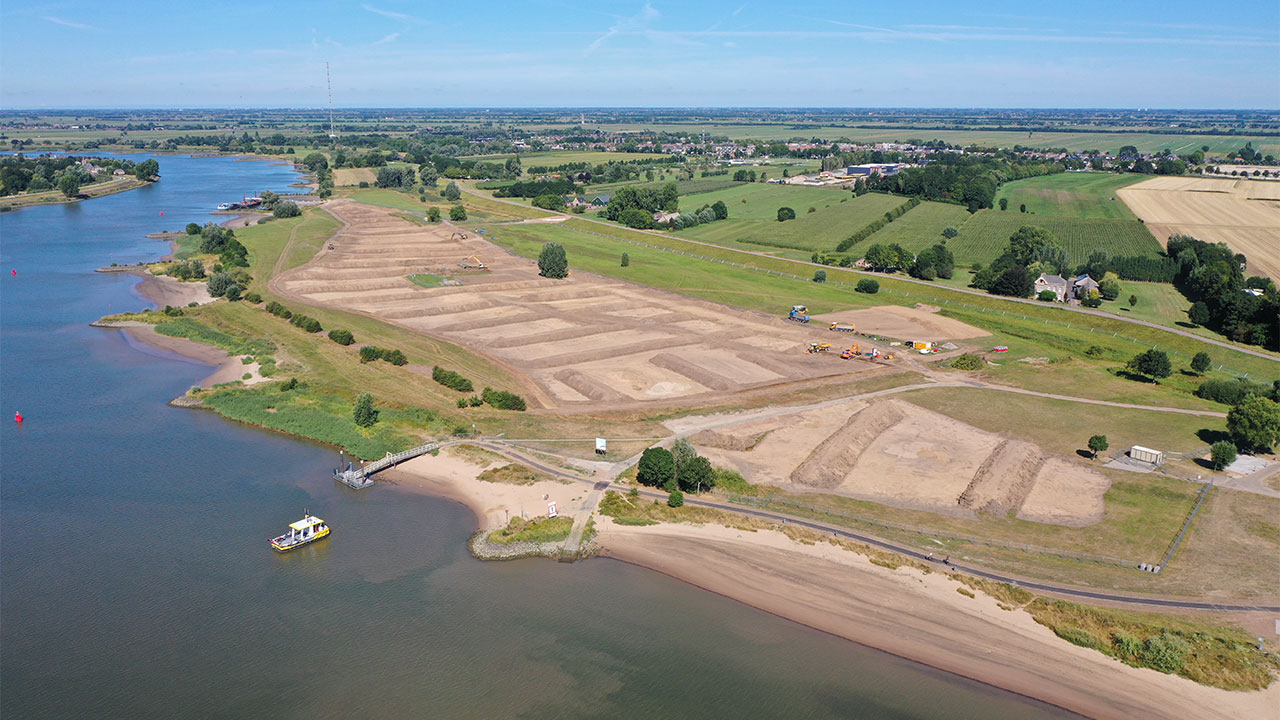
The Lekdijk is a river dike that protects a large part of the central and western part of The Netherlands against flooding, from the Lek, a major river in the area.
If this dike were breached, nearly a million people in this densely populated and economically valuable area could face flooding and tens of billions of Euros in damage could occur unless measures are put in place to prevent this.
Challenge
The Lekdijk needed to be reinforced over 55 kilometres, from Amerongen to Schoonhoven, as it no longer met current safety standards. Hoogheemraadschap De Stichtse Rijnlanden (HDSR) is a water regulatory board in the Netherlands, with a goal to ensure that the dike remains well integrated into the landscape and the surrounding area. Where possible, opportunities for the development of (river) nature, recreation, cultural history and mobility are explored, with the preservation of the environment as a top priority. Simply raising and widening the dike was therefore not an option, with more innovative solutions needed. The starting point was to find sustainable and innovative solutions that could have a positive impact on the environment. Another goal of the Water Board was to significantly reduce emissions by the end of the project.
Expertise
Mourik Infra is one of three main contractors that were assigned for this project, and Tetra Tech has joined as a subcontractor for this. We have been tasked with the design and construction of two of the six sub-projects scheduled to run over the next 10 years. To this end, Tetra Tech works closely together with Mourik Infra and the Water Board (HDSR).
We have the important task of developing and implementing innovative technical solutions in the design phase of the project. For example, our engineers have identified a practical and sustainable solution to re-purpose excavated material (clay), from the river bedding to reinforce the dike. We create social value using this approach, by promoting new nature and biodiversity, combined with the planned dike reinforcement.
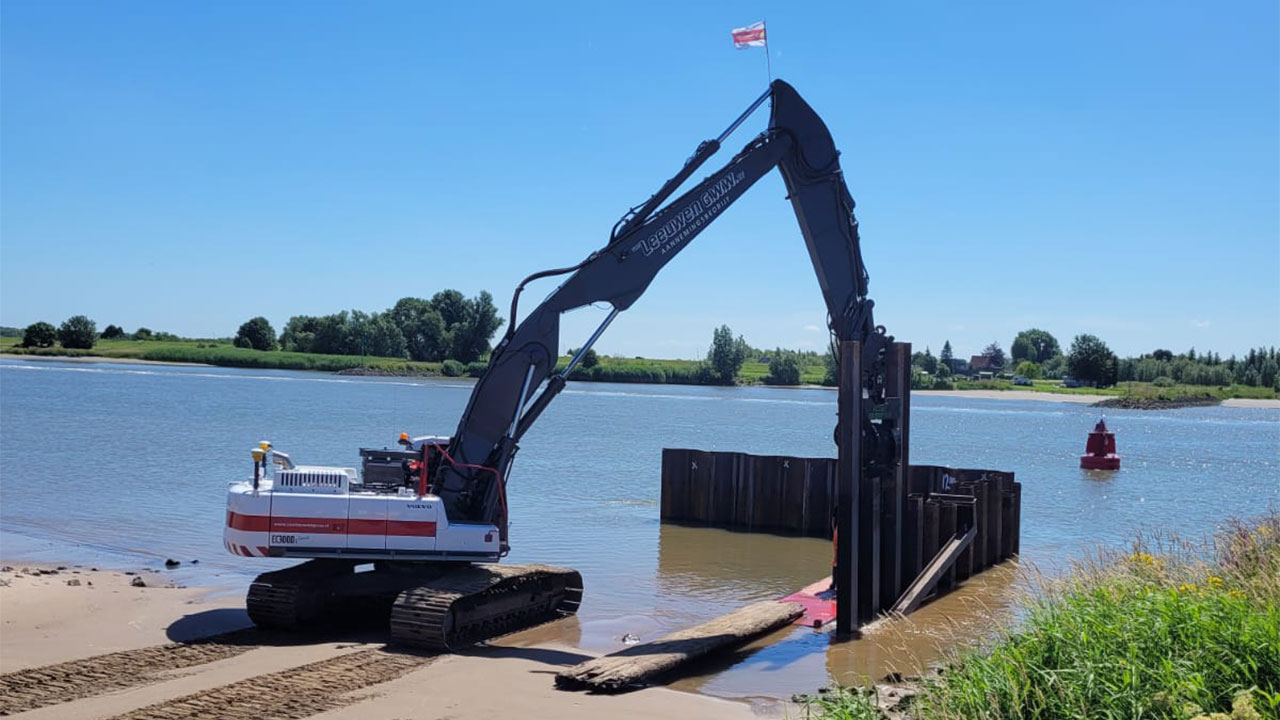
Our team generated and applied new modelling techniques to optimize the design and reduce the use of building material. Furthermore, the Prolock Delta Filter Sheet pile, a brand new and state-of-the-art reinforcement technique, was developed, tested, and applied. This perforated PVC sheet pile construction is designed to protect the dike against any failure due to ‘piping’. The vertical construction is permeable to water but does not allow sand grains to pass through. As a result, the ‘pipe’ developing under the landside slope during high water levels in the river, is halted in its tracks by the construction.
With this relatively simple and sustainable technique, the waterboard saves a lot of space. The construction is hidden underground to protect the visual aesthetic of the existing landscape. Specialists from Tetra Tech contributed to the design and testing of this innovative solution, and its implementation with the design of the dike reinforcement. The final goal achieved within this project was sharing knowledge and experience gained on a broader scale. This would ensure that sustainable techniques are successfully applied within different projects.
How significant was the project?
This was a significant project for The Netherlands, as it helped to keep an important part of the country safeguarded against the risks of flooding. The project produced innovative calculation methods and dike reinforcement techniques that could be applied on a wider scale, elsewhere in The Netherlands. This will help keep the country safe against the increasing risk of flooding and the challenges of climate change. The innovative reinforcement techniques helps to promote The Netherlands towards implementing sustainable solutions compared to traditional ’piping methods’. These new solutions are environmentally sustainable solutions will help preserve the natural landscape.
The project was worth €1,300,000 and the team developed expertise in state-of-the art dike reinforcement and deepened their understanding of new calculation techniques, which also contributed to the sustainability goals of the client.
ESG and Sustainability project attributes
By applying new technical solutions during the design phase of the project we were able to use fewer building materials, maintain biodiversity, and protect the natural environment.
The project featured in this article was undertaken by RPS, A Tetra Tech Company and originally published on RPSgroup.com. In March 2026 RPS rebranded to Tetra Tech.